Corporate Tax vs VAT in UAE
Introduction
The UAE has always been a business-friendly destination with a tax-friendly environment. But with the introduction of Corporate Tax and Value Added Tax (VAT), businesses operating in the UAE must have a clear understanding of the functioning of these two systems.
If you are thinking of starting a business, or you already run one, knowing the difference between Corporate Tax and VAT is essential for compliance and financial planning.
What is Corporate Tax in UAE?
Corporate Tax :
- It is a direct tax levied on the net profit of companies.
- Launched in June 2023
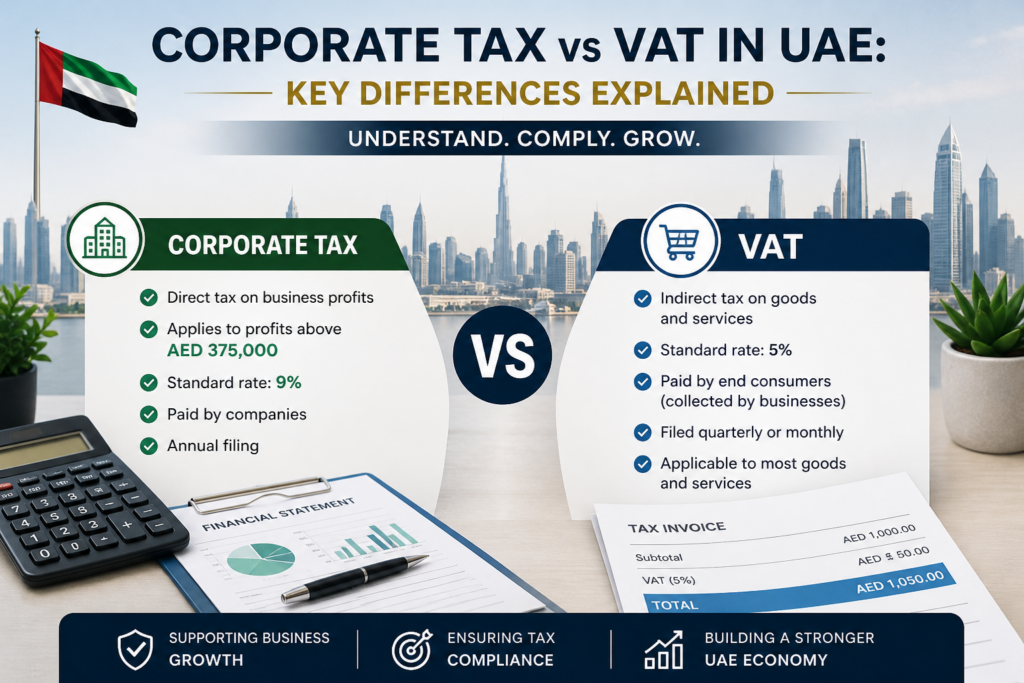
- Applies to business profits above AED 375,000
- Regular rate: 9%
- Small businesses and start-ups below the threshold: Taxed at 0%
Key Features:
- Using annual profits
- Paid by the company directly
- Fosters transparency & worldwide compliance
- UAE to comply with global tax standards
What is VAT in UAE?
- Value Added Tax (VAT) is an indirect tax on the consumption of goods and services.
- Launched in January 2018
- 5% standard rate
- Collected at each step of the supply chain
Key Features:
- Paid by the end customer
- Companies are tax collectors.
- Quarterly or monthly filing
- Applies to most goods and services (some exemptions apply)
Corporate Tax vs VAT: Key Differences
1. Nature of Tax
- Corporate Tax → Direct tax on business profits
- VAT → Indirect tax on consumption
2. Who Pays the Tax?
- Corporate Tax → Paid by companies
- VAT → Ultimately paid by consumers (collected by businesses)
3. Basis of Calculation
- Corporate Tax → Net profit after expenses
- VAT → Percentage of transaction value
4. Filing Requirements
- Corporate Tax → Annual filing
- VAT → Quarterly/Monthly filing
5. Impact on Pricing
- Corporate Tax → Does not directly affect product pricing
- VAT → Added to final selling price
Example to Understand Easily
Let’s say a company sells a product for AED 1,000:
- VAT (5%) = AED 50 → Paid by customer
- Company collects and submits it to government
Now, if the company makes AED 500,000 profit:
- First AED 375,000 → 0% tax
- Remaining AED 125,000 → 9% Corporate Tax
Why Understanding Both is Important
The two taxes have different purposes for the businesses in UAE:
- VAT gives a regular revenue stream for government from consumption
- Corporate Tax targets the profits of businesses
Failure to comply with either may lead to:
- Sanctions
- Legal matters
- Business Interruption (BI)
Compliance Tips for UAE Businesses
- Keep financial records up to date
- Register for VAT if turnover is above AED 375,000
- Know the Corporate Tax Thresholds
- Returns files in due time
- Consult tax consultants or financial advisors
Conclusion
Corporate Tax and VAT are both key elements of the UAE’s evolving tax system but they perform totally different functions.
Corporate Tax is on business profits.
VAT is consumption based.
Understanding the difference enables businesses to remain compliant, optimize tax planning, and avoid unnecessary penalties.
For More Details Connect Our Expert:- https://irtiqaalfalah.com