Invoice Validation Rules Every UAE Business Should Understand
For businesses in the UAE, an invoice is more than a document requesting payment. A properly prepared invoice can support accounting records, VAT compliance, financial reporting, customer communication and audit readiness.
A missing Tax Registration Number (TRN), incorrect VAT calculation, duplicate invoice number or incomplete customer information can create accounting problems and make financial reviews more difficult.
With the UAE moving towards structured electronic invoicing, businesses should also make invoice validation part of their broader digital accounting and compliance strategy.
In simple terms, invoice validation means checking an invoice for accuracy, completeness, tax compliance and internal approval before it is issued, recorded or processed.
What Are Invoice Validation Rules in the UAE?
Invoice validation rules UAE businesses follow are the checks used to confirm that an invoice contains the required information, calculates VAT correctly and matches the underlying transaction.
A proper validation process normally checks:
- Supplier information
- Customer information
- TRN details where applicable
- Invoice number
- Invoice date
- Supply date where required
- Description of goods or services
- Quantity and unit price
- VAT rate
- VAT amount
- Total amount
- Currency and exchange-rate information where applicable
- Discounts and adjustments
- Supporting documents
- Payment terms
The Federal Tax Authority states that a standard full tax invoice should contain specific information, including the words “Tax Invoice”, a sequential or unique invoice number, issue date, supplier details and TRN, recipient details and TRN where registered, descriptions of supplies, unit price, quantity or volume, VAT rate and amount payable in AED.
Why Is Invoice Validation Important for UAE Businesses?
Invoice errors can affect much more than the invoice itself.
Incorrect information can lead to:
- Delayed customer payments
- Incorrect VAT records
- Difficulties during reconciliation
- Duplicate transactions
- Inaccurate financial reports
- Audit queries
- Tax compliance issues
- Additional administrative work
For this reason, businesses often use professional accounting services in Dubai or bookkeeping services in Dubai to maintain accurate transaction records and establish consistent invoice-processing procedures.
A strong invoice validation process also gives management better visibility into revenue, receivables, expenses and cash flow.
What Information Should a UAE Tax Invoice Contain?
Before issuing a tax invoice, businesses should verify the following core information.
1. Tax Invoice Label
The invoice should clearly identify itself as a tax invoice where applicable.
2. Unique Invoice Number
Every invoice should have a sequential or unique identification number that allows the transaction to be traced.
3. Invoice Date
The date on which the tax invoice is issued should be clearly displayed.
4. Supplier Details
Include relevant supplier information such as:
- Legal business name
- Address
- Tax Registration Number (TRN)
5. Customer Details
The recipient’s relevant details should be included, including the TRN where the recipient is VAT registered and the rules require it.
6. Description of Goods or Services
The invoice should clearly explain what was supplied.
7. Quantity and Unit Price
Each applicable item should show the quantity or volume and unit price.
8. VAT Rate and VAT Amount
The applicable VAT rate and amount should be calculated correctly.
9. Total Amount
The invoice should clearly show the amount payable in AED as required.
10. Additional Information Where Applicable
Certain transactions may require additional information, such as supply dates, discounts, exchange rates or references to reverse-charge arrangements.
The FTA also notes that foreign-currency tax invoices must show the VAT amount converted to AED and the exchange rate used, while rounding should be performed at the line-item level to the nearest fils.
Invoice Validation Checklist for UAE Businesses
A practical validation checklist can help accounting teams identify errors before an invoice reaches the customer.
Basic Invoice Checks
- Correct invoice number
- Correct invoice date
- Correct supplier name
- Correct supplier TRN
- Correct customer details
- Correct customer TRN where applicable
- Accurate description of goods or services
- Correct quantity
- Correct unit price
- Correct VAT treatment
- Correct VAT amount
- Correct total amount
- Correct currency information
- Required supporting documents attached
Internal Control Checks
- Invoice matches the purchase order or agreement
- The invoice is not a duplicate
- Required approval has been obtained
- Discounts are correctly recorded
- Credit notes or adjustments are properly referenced
- Accounting records are updated
- The invoice is stored securely
Common Invoice Errors UAE Businesses Should Avoid
Even established businesses can experience invoice errors when processes are manual or poorly controlled.
Duplicate Invoice Numbers
Duplicate invoice numbers can make transaction tracking and reconciliation difficult.
Incorrect VAT Calculation
An incorrect VAT amount can affect both the invoice and the company’s tax records.
Incorrect TRN
A wrong or missing TRN can create problems when validating tax documentation.
Missing Customer Information
Incomplete customer information can make invoices harder to verify and process.
Incorrect Quantity or Price
The quantity and unit price should match the underlying quotation, purchase order or agreement.
Incorrect Date
Invoice and supply dates should be checked carefully, particularly when the dates affect tax reporting.
Wrong VAT Treatment
Businesses should apply the correct VAT treatment to the transaction rather than automatically applying the same treatment to every invoice.
Poor Record Keeping
Invoices should be retained with relevant supporting records so transactions can be traced when required.
The FTA states that taxable individuals must retain VAT invoices and related records for a minimum period prescribed under UAE tax rules.
How Invoice Validation Supports VAT Compliance
Invoice validation is closely connected to VAT compliance.
A business needs reliable transaction information to prepare accurate VAT records and returns. If invoice data contains errors, those errors can flow into bookkeeping, reconciliation and tax reporting.
A proper validation process can help businesses:
- Maintain accurate VAT documentation
- Reduce calculation errors
- Identify missing information
- Improve transaction traceability
- Prepare cleaner accounting records
- Support VAT return preparation
- Improve audit readiness
Businesses that need specialised support can work with VAT Consultancy Services in Dubai or professional VAT Consultancy Services in the UAE to review their VAT processes.
Invoice Validation and UAE E-Invoicing
The UAE’s move towards electronic invoicing makes invoice data quality even more important.
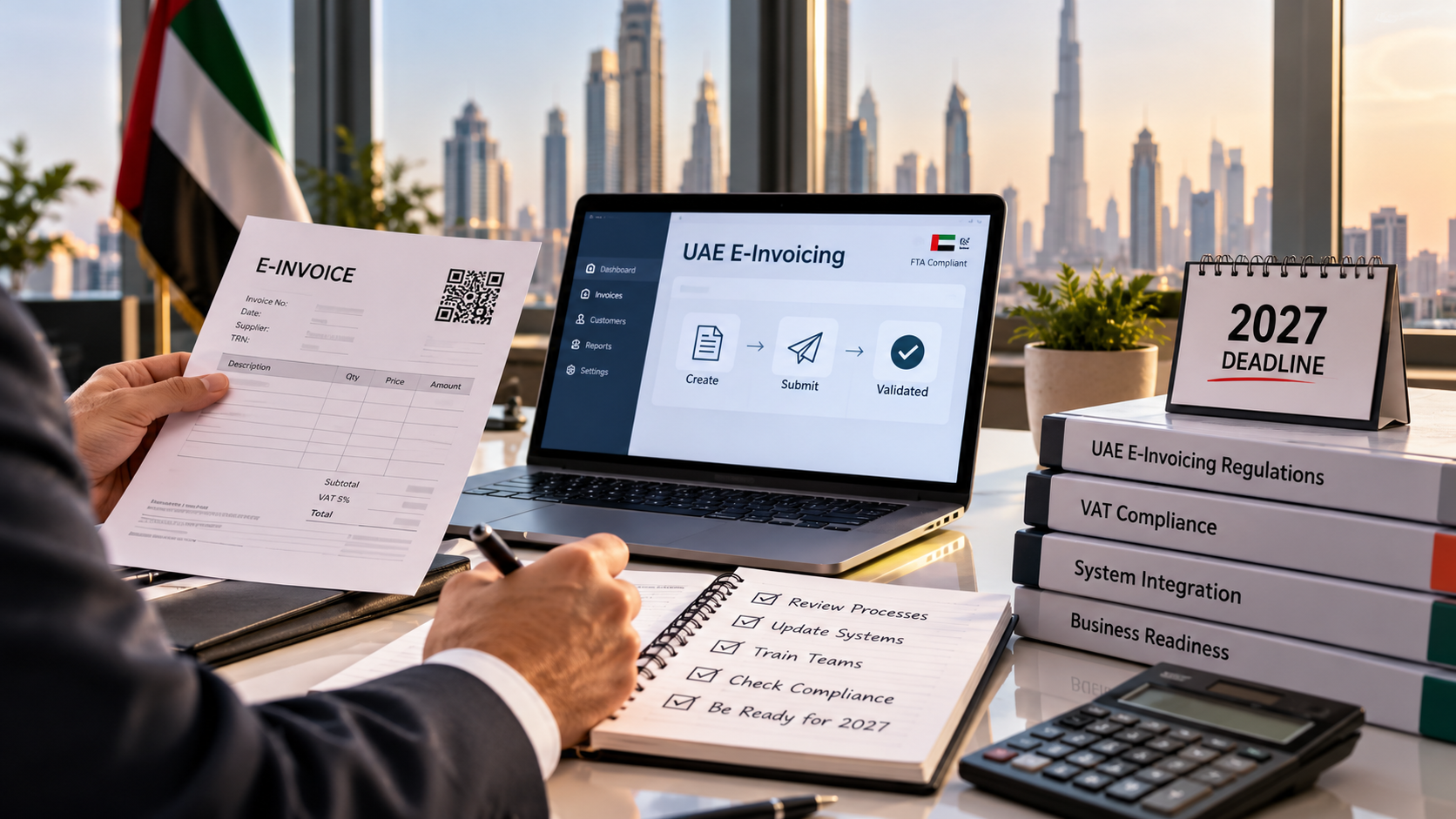
According to the UAE Ministry of Finance, an eInvoice is structured invoice data that is electronically issued and exchanged between a supplier and buyer and reported through the UAE eInvoicing framework. A PDF, Word document, scanned invoice, image or email attachment by itself is not considered an eInvoice.
This means businesses should not think of e-invoicing simply as converting a paper invoice into a PDF.
Electronic invoicing is a structured digital process involving standardised data, systems and electronic exchange.
Businesses looking for E-Invoicing Services in Dubai, E-Invoicing Services in Dubai Marina, E-Invoicing Services in Jumeirah, E-Invoicing Services in Palm Jumeirah, E-Invoicing Services in JLT, E-Invoicing Services in Al Qusais or E-Invoicing Services in Downtown Dubai should focus on system readiness, data accuracy and compliance rather than simply changing the invoice format.
UAE E-Invoicing Timeline: What Businesses Should Know
The UAE is implementing e-invoicing in phases.
The Ministry of Finance’s June 2026 guidance states that voluntary e-invoicing can begin from 1 July 2026, while mandatory implementation is phased according to business revenue.
For businesses with annual revenue of AED 50 million or more, mandatory implementation is scheduled for 1 January 2027. The Ministry later extended the deadline for appointing an Accredited Service Provider (ASP) for these businesses to 30 October 2026, while confirming that the 1 January 2027 implementation date remains unchanged.
For businesses with annual revenue below AED 50 million, the current published guidance provides for:
| Business Category | ASP Appointment Deadline | Mandatory Implementation |
| Revenue ≥ AED 50 million | 30 October 2026* | 1 January 2027 |
| Revenue < AED 50 million | 31 March 2027 | 1 July 2027 |
| Government entities | 31 March 2027 | 1 October 2027 |
*The October 2026 ASP deadline reflects the Ministry of Finance’s May 2026 amendment; the mandatory implementation date for businesses above AED 50 million remains 1 January 2027.
Because implementation requirements can evolve, businesses should always check the latest official Ministry of Finance and Federal Tax Authority guidance before making compliance decisions.
What Is the Difference Between a PDF Invoice and an E-Invoice?
This is an important distinction for businesses preparing for UAE e-invoicing.
| PDF / Traditional Invoice | Electronic Invoice |
| Can be created as a PDF | Uses structured invoice data |
| May be emailed manually | Exchanged electronically through the required framework |
| Data may require manual entry | Structured data can support automation |
| Not automatically an eInvoice | Designed to meet eInvoicing requirements |
| May require manual validation | Can support automated validation |
The Ministry of Finance specifically confirms that PDFs, Word files, images and scanned copies are not eInvoices simply because they are electronic files.
How Accounting Software Can Automate Invoice Validation
Manual invoice checking can become difficult when a business processes hundreds or thousands of transactions.
Modern accounting and ERP systems can help automate checks such as:
- Duplicate invoice detection
- Mandatory-field validation
- VAT calculations
- Customer and supplier matching
- Purchase order matching
- Approval workflows
- Data synchronisation
- Digital record keeping
- Reporting
Automation does not remove the need for professional review. Instead, it can reduce repetitive work and help accounting teams identify exceptions faster.
This is one reason businesses consider accounting consultancy in Dubai when selecting or upgrading accounting systems.
Strengthening Internal Controls Around Invoices
Invoice validation should be part of a broader internal control system.
A strong process may include:
Segregation of Duties
Where practical, the person preparing an invoice should not have unrestricted authority to approve and modify the same transaction.
Approval Workflows
Set approval levels based on transaction type, amount or department.
Access Controls
Limit who can create, edit, approve or cancel invoices.
Regular Reconciliation
Compare invoices with bank records, customer balances, purchase orders and accounting entries.
Exception Reporting
Create reports for duplicate invoices, unusual transactions, missing information and unexpected VAT values.
Businesses may use internal audit services in Dubai or work with internal audit firms in Dubai to review financial controls and identify weaknesses.
How Professional Accounting and Bookkeeping Services Can Help
As transaction volumes grow, maintaining accurate invoices manually can become increasingly difficult.
Professional accounting and bookkeeping services in Dubai can help businesses establish organised processes for:
- Invoice recording
- Accounts receivable
- Accounts payable
- Bank reconciliation
- VAT documentation
- Financial reporting
- Transaction verification
- Record keeping
- Month-end closing
Accounting Outsourcing Dubai offers a solution for companies that prefer not to maintain a large internal accounting department, allowing them to manage routine financial processes.
Businesses located in different parts of Dubai may also search for specialized support such as:
- Accounting Firms in Business Bay Dubai
- Bookkeeping Services in Business Bay
- Audit Firms in Business Bay
- Accounting Services in Palm Jumeirah
- Bookkeeping Services in Palm Jumeirah
- Bookkeeping Services in Jumeirah
- Corporate Tax Services in Jumeirah
- Accounting Services Near Me
- Accounting Firms Near Me
- Tax Consultant in Dubai
- Tax Consulting Firms in Dubai
For businesses outside Dubai, similar requirements apply when searching for accounting services in Sharjah or other UAE accounting providers.
Invoice Validation for Audit Readiness
A well-organised invoice system can make audits easier because transactions can be traced back to supporting documents.
Auditors may need to understand:
- Where a transaction originated
- Who approved it
- What goods or services were supplied
- How the amount was calculated
- How VAT was treated
- How the transaction was recorded
- Which supporting documents are available
This is why audit services in Dubai and the auditing of accounting processes often depend on the quality and organisation of the underlying financial records.
Good invoice controls can therefore support both day-to-day accounting and longer-term financial governance.
What Should a UAE Business Do Before Issuing an Invoice?
A simple five-step process can improve invoice accuracy:
Step 1: Verify the Customer
Check the customer name, address and TRN where applicable.
Step 2: Verify the Transaction
Compare the invoice against the quotation, contract, purchase order or delivery documentation.
Step 3: Check VAT
Confirm the correct VAT treatment, rate and calculation.
Step 4: Validate the Invoice
Check invoice numbering, dates, descriptions, amounts and required fields.
Step 5: Approve and Record
Obtain the required approval, issue the invoice and record it accurately in the accounting system.
Key Benefits of a Strong Invoice Validation Process
A structured invoice validation process can help businesses achieve:
Better Accuracy: Fewer manual errors and duplicate records.
Improved Compliance: More reliable VAT and financial documentation.
Faster Processing: Less time spent correcting invoices.
Better Cash Flow: Accurate invoices can reduce unnecessary payment delays.
Stronger Audit Readiness: Supporting documents and transaction records are easier to trace.
E-Invoicing Readiness: Clean and structured financial data makes digital transformation easier.
Better Financial Reporting: Accurate source data supports more reliable management reports.
Frequently Asked Questions About Invoice Validation Rules UAE
What are invoice validation rules in the UAE?
Invoice validation rules are the checks businesses use to ensure that invoices contain the required information, accurately represent the transaction and follow applicable VAT and accounting requirements.
What information should a UAE tax invoice contain?
A standard tax invoice generally needs information such as the Tax Invoice label, unique or sequential invoice number, issue date, supplier details and TRN, recipient details where applicable, description of supplies, quantity, unit price, VAT rate, VAT amount and total amount payable. Additional requirements can apply depending on the transaction.
Is a PDF considered an eInvoice in the UAE?
No. A PDF, Word document, scanned copy, image or email attachment is not considered an eInvoice merely because it is digital. UAE eInvoicing uses structured invoice data exchanged through the applicable electronic framework.
When will UAE e-invoicing become mandatory?
Mandatory implementation is being introduced in phases. Businesses with annual revenue of AED 50 million or more are scheduled for mandatory implementation from 1 January 2027, while businesses below AED 50 million are scheduled for 1 July 2027.
Can accounting software validate invoices automatically?
Yes. Depending on the system, accounting software can automate checks for mandatory fields, duplicate invoices, VAT calculations, approvals and transaction matching.
Why should businesses use bookkeeping services in Dubai?
Professional bookkeeping can help businesses maintain accurate financial records, reconcile transactions, organise invoices and support VAT and financial reporting processes.
Are invoice validation and VAT compliance connected?
Yes. Accurate invoice data supports reliable VAT records and reporting. Businesses should ensure that invoices reflect the correct tax treatment and required information.
What is the role of internal audit in invoice validation?
Internal audit can review invoice workflows, approval controls, access permissions, reconciliation processes and other financial controls to identify weaknesses and improve governance.
Final Thoughts
Invoice validation should not be treated as a simple administrative task. For UAE businesses, it is an important part of accounting accuracy, VAT compliance, financial control and preparation for electronic invoicing.
Businesses should verify invoice numbers, supplier and customer information, TRNs, descriptions, prices, VAT calculations and supporting documentation before issuing or recording invoices.
As the UAE’s e-invoicing framework develops, businesses should also focus on structured financial data, accounting-system readiness and reliable internal controls. The Ministry of Finance has encouraged businesses to prepare early and work with Accredited Service Providers as applicable.
Whether a business needs accounting services in Dubai, Bookkeeping Services in Dubai, VAT Consultancy Services in Dubai, internal audit services in Dubai, Tax Consulting Firms in Dubai, Accounting Consultancy in Dubai or e-invoicing support, the objective should remain the same: accurate records, efficient processes and strong financial compliance.
Quick Invoice Validation Checklist
Before issuing any invoice, ask:
Is the invoice number unique?
Are supplier and customer details correct?
Is the applicable TRN included?
Is the description accurate?
Are quantity and prices correct?
Is the VAT treatment correct?
Is the VAT amount accurate?
Is the total correct?
Are supporting documents available?
Has the invoice passed the required approval process?
Is the accounting system recording the transaction correctly?
If the answer to all of these is yes, your invoice process is in a much stronger position for accurate bookkeeping, VAT compliance, audit preparation and future e-invoicing requirements.
Important: UAE tax and e-invoicing requirements can change. Businesses should verify the latest requirements with the UAE Ministry of Finance, the Federal Tax Authority or a qualified UAE tax/accounting professional before making compliance decisions.