Key UAE E-Invoicing Rules, Important Deadlines & Compliance Steps for Businesses in 2026–2027
The UAE e-invoicing system 2026-2027 is one of the most important digital tax developments for businesses operating in the United Arab Emirates. The UAE Ministry of Finance is introducing a formal electronic invoicing system to enhance the efficiency, transparency, security and digital connectivity of business transactions with the Federal Tax Authority (FTA).
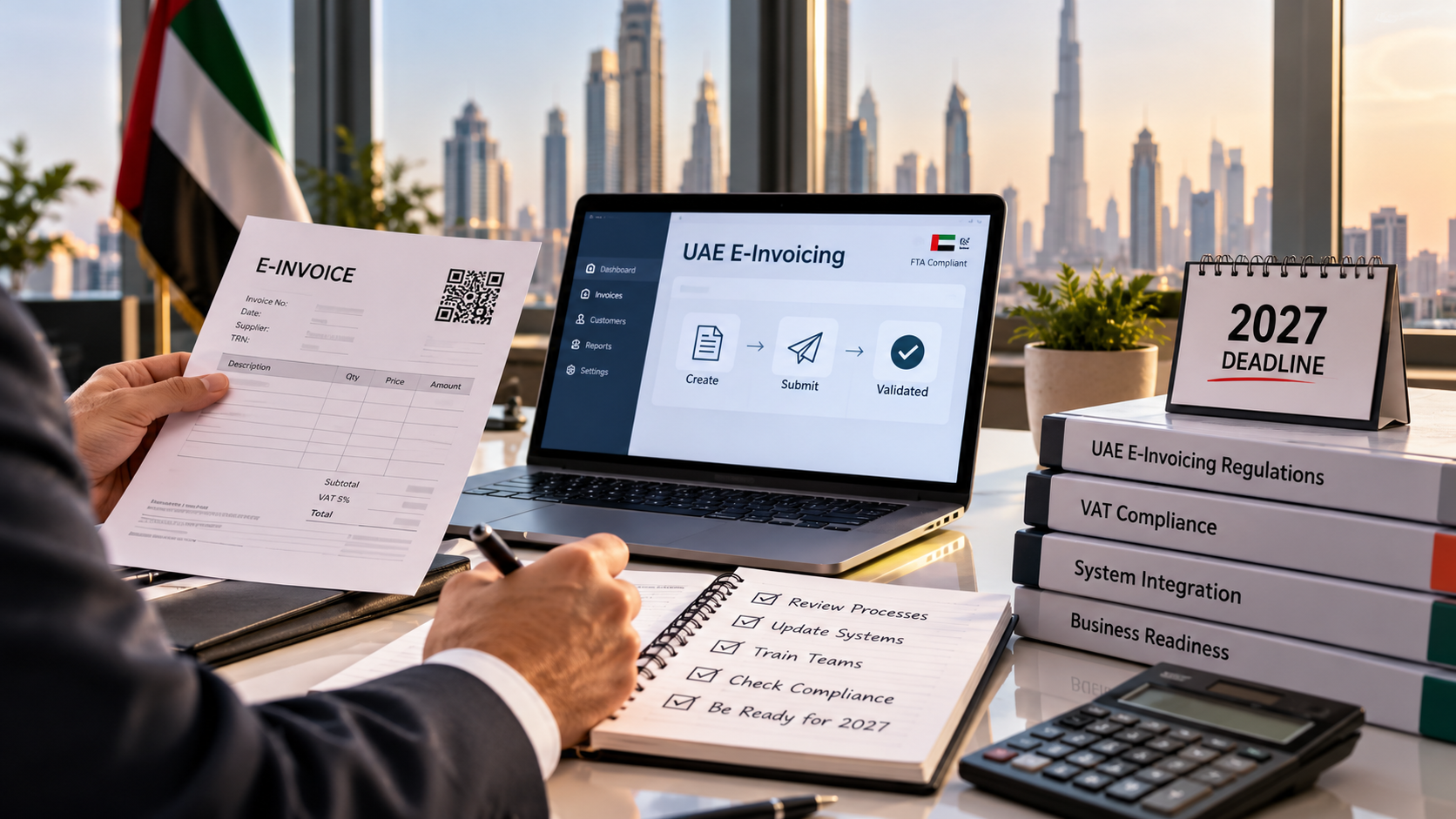
Implementation is being rolled out in phases. Businesses with annual revenue of AED 50 million and above will have to comply with e-invoicing from 1 January 2027. Businesses with annual revenue of less than AED 50 million have a later implementation deadline of 1 July 2027.
There has also been a significant 2026 update: The deadline for businesses with an annual revenue of AED 50 million or more to appoint an Accredited Service Provider (ASP) has been extended from 31 July 2026 to 30 October 2026. The mandatory implementation date of January 1, 2027, is unchanged.
This guide covers the rules, deadlines, eligibility, accredited service providers, implementation requirements, benefits and practical steps businesses should take in 2026 for UAE e-invoicing.
What Is UAE E-Invoicing?
UAE e-invoicing is a formal process of digital invoices where the invoice data is prepared electronically, exchanged between supplier and buyer and reported to the UAE Federal Tax Authority.
The important point to note here is that an e-invoice is not merely a PDF invoice emailed.
PDFs, Word documents, images, scanned invoices, and invoices sent by email are unstructured formats and therefore not eInvoices, the UAE Ministry of Finance said. The structured invoice data of a UAE eInvoice shall be electronically processed and exchanged under the approved framework.
In simple terms:
Traditional invoice:
Business → PDF/printed invoice → Customer
UAE e-Invoice:
Supplier → Accredited Service Provider → Buyer/recipient + electronic reporting to FTA
The UAE system is based on the Peppol 4-Corner Model, which is designed to support secure and interoperable electronic invoice exchange.
UAE E-Invoicing 2026–2027: Key Deadlines
Understanding the deadlines is one of the most important parts of preparing for UAE e-invoicing.
Current UAE e-Invoicing timeline
| Business / Entity | ASP Appointment Deadline | Mandatory Implementation |
| Business with annual revenue ≥ AED 50 million | 30 October 2026 | 1 January 2027 |
| Business with annual revenue < AED 50 million | 31 March 2027 | 1 July 2027 |
| Government Entity | 31 March 2027 | 1 October 2027 |
The original timeline was amended in May 2026 for businesses with annual revenue of AED 50 million or more. Their ASP appointment deadline was extended to 30 October 2026, but the mandatory implementation date remains 1 January 2027.
Why this matters
The ASP appointment deadline should not be confused with the deadline for the implementation of e-invoicing by businesses.
For example, a business with an annual turnover of AED 60 million has until 30 October 2026 to appoint its Accredited Service Provider but still needs to be ready to have the system up and running by 1 January 2027.
UAE E-Invoicing Pilot and Voluntary Adoption
UAE e-Invoicing went live on 1 July 2026 with a pilot phase for a limited group of taxpayers.
The Ministry of Finance also confirmed that businesses may voluntarily apply e-invoicing from 1 July 2026 regardless of revenue if they meet the applicable technical requirements.
Voluntary implementation can help companies:
- Test their accounting systems.
- Locate holes in data
- How to understand the e-invoicing process
- Train the finance teams
- Enhance the quality of invoice data
- Integration to test with an approved service provider
- ready for compulsory enforcement
For businesses that are not yet started, waiting until the last minute can create undue pressure to implement.
Who Is Required to Follow UAE E-Invoicing Rules?
The UAE e-Invoicing framework applies broadly to individuals conducting business in the UAE in relation to business-to-business (B2B) and business-to-government (B2G) transactions, subject to specified exclusions.
The implementation is being phased according to revenue and entity type.
Businesses with revenue of AED 50 million or more
These businesses are the first major group entering mandatory implementation.
They must:
- Appoint an Accredited Service Provider by 30 October 2026
- Prepare their systems and processes
- Complete required onboarding
- Implement UAE e-Invoicing by 1 January 2027
The implementation deadline itself was not extended in the May 2026 amendment.
Businesses with revenue below AED 50 million
These businesses have a later phase.
They must appoint an accredited service provider by 31 March 2027 and implement the UAE e-invoicing system by 1 July 2027.
Government entities
Government entities must appoint an accredited service provider by 31 March 2027 and implement the system by 1 October 2027.
What Is an Accredited Service Provider (ASP)?
An Accredited Service Provider (ASP) is an approved service provider that enables businesses to connect with the UAE e-invoicing system.
The Ministry of Finance maintains an official list of Accredited Service Providers and periodically updates it.
An ASP can help a business with activities such as:
- Sending structured e-invoices
- Receiving e-invoices
- Connecting accounting or ERP systems
- Supporting invoice data exchange
- Meeting technical requirements
- Supporting onboarding
- Facilitating electronic reporting
- Maintaining appropriate data flows
Businesses should select an ASP based on their business requirements, accounting system, transaction volume, integration requirements, security needs and support capabilities.
How Does UAE E-Invoicing Work?
The UAE has adopted a 4-Corner Model for e-Invoicing.
The basic structure involves:
Corner 1: Supplier
↓
Corner 2: Supplier’s Accredited Service Provider
↓
Corner 3: Buyer’s Accredited Service Provider
↓
Corner 4: Buyer
The system supports electronic exchange of structured invoice data through accredited channels.
The Ministry of Finance introduced the UAE e-Invoicing 4-Corner Model in April 2026 as part of the country’s move towards an integrated digital invoicing ecosystem.
What Information Should an Electronic Invoice Contain?
UAE e-Invoices must contain the required data fields and particulars prescribed under the applicable UAE e-Invoicing framework.
Depending on the transaction and applicable requirements, invoice data can include information such as:
- Supplier information
- Buyer information
- Tax registration details
- Invoice number
- Invoice date
- Description of goods or services
- Quantity
- Price
- Tax information
- Total amount
- Currency
- Credit note information where applicable
Businesses should not rely on a generic invoice template alone. Their systems need to be capable of generating the structured data required by the UAE framework.
The Ministry of Finance has published official mandatory field requirements and e-invoicing guidelines to support businesses during implementation.
Are PDF Invoices Considered E-Invoices in the UAE?
No.
A PDF invoice, scanned document, image, Word document or invoice sent as an email attachment is not considered a UAE eInvoice under the official framework.
This distinction is critical for businesses preparing for the transition.
Simply changing from paper invoices to PDF invoices does not mean that a company has implemented UAE e-invoicing.
The invoice must be structured and exchanged through the required electronic framework.
Is E-Invoicing Mandatory for B2C Transactions?
Under the current framework, B2C transactions are not subject to the mandatory e-Invoicing system at this stage, and individuals operating exclusively in B2C transactions are not subject to the system until a future decision determines otherwise.
Businesses should nevertheless monitor official UAE announcements, as the e-Invoicing programme may evolve.
What Are the Benefits of E-Invoicing for Small and Medium Businesses?
The UAE e-Invoicing programme is not just about tax compliance; it also provides operational benefits for businesses.
It can also provide operational benefits for businesses.
1. Faster invoice processing
Electronic invoice exchange can reduce manual data entry and repetitive administrative tasks.
2. Better financial visibility
Structured invoice information can help businesses improve the quality and accessibility of financial data.
3. Reduced errors
Automated processes can reduce errors caused by manual invoice entry and duplication.
4. Improved compliance
Electronic reporting and structured data can support more efficient tax compliance and reporting processes.
5. Less paperwork
Digital invoicing can reduce reliance on paper-based processes and support more sustainable business operations.
6. Better cash-flow management
Faster invoice processing and improved visibility can help businesses monitor receivables and payment cycles more effectively.
7. Easier accounting integration
A properly configured e-Invoicing solution can integrate with accounting and ERP systems, reducing repetitive manual work.
The UAE Federal Tax Authority identifies digitalisation, efficiency, security, reduced fraud risks and improved tax compliance among the key objectives of e-invoicing.
How Should Businesses Prepare for UAE E-Invoicing?
Businesses should treat e-invoicing implementation as a business and technology project, not simply an accounting software update.
Step 1: Determine your implementation phase.
Start by identifying:
- Annual revenue
- Business structure
- B2B transactions
- B2G transactions
- B2C transactions
- Current accounting system
- ERP system
- Invoice volume
This information will help determine the applicable implementation timeline.
Step 2: Review your current invoicing process.
Document how invoices currently move through your business.
For example:
Sales → Invoice creation → Approval → Customer → Accounting → VAT reporting
Then identify where e-Invoicing will change the workflow.
Step 3: Check your accounting or ERP system.
Your accounting system needs to support the technical requirements necessary for UAE e-invoicing.
Businesses should speak with their software provider and determine whether the existing system can integrate with an accredited service provider.
Step 4: Select an Accredited Service Provider
The UAE Ministry of Finance publishes an official list of Accredited Service Providers.
Businesses should compare providers based on:
- Technical compatibility
- Integration options
- Security
- Data handling
- Support
- Scalability
- Pricing
- Implementation assistance
The official ASP list is maintained by the Ministry of Finance and is updated periodically.
Step 5: Clean your customer and supplier data.
Poor-quality master data can create problems during e-Invoicing implementation.
Review:
- Customer names
- Supplier information
- Tax registration numbers
- Addresses
- Contact details
- Product/service information
- Tax treatment
- Payment information
Data cleansing should be completed before implementation rather than after problems appear.
Step 6: Test the system
Before mandatory implementation, businesses should test:
- Invoice creation
- Invoice transmission
- Invoice receipt
- Credit notes
- Tax information
- Customer data
- Supplier data
- Error handling
- System integration
- Reporting
Testing gives finance and IT teams time to resolve issues.
Step 7: Train your finance team.
Employees should understand:
- What qualifies as an eInvoice
- How invoices are generated
- How credit notes work
- What happens when an invoice fails
- How customer information is maintained
- How the accounting system interacts with the ASP
Technology alone will not guarantee compliance.
UAE E-Invoicing and VAT: What Is the Connection?
E-invoicing and VAT are closely connected, but they are not the same thing.
VAT is a tax imposed on taxable supplies under UAE VAT legislation.
E-invoicing is a digital system for creating, exchanging and reporting structured invoice data.
Businesses therefore need to consider both:
VAT compliance + E-invoicing compliance
For example, an e-invoice still needs to contain the appropriate VAT information where VAT applies.
This is why businesses may benefit from professional VAT consultancy services in the UAE alongside their e-invoicing implementation.
E-Invoicing Services in Dubai: Why Businesses Should Prepare Early
Dubai businesses are increasingly moving towards digital accounting and tax processes.
Companies searching for E-Invoicing Services in Dubai, E-Invoicing Services in Dubai Marina, E-Invoicing Services in Downtown Dubai, E-Invoicing Services in Jumeirah, E-Invoicing Services in Palm Jumeirah, or E-Invoicing Services in JLT should focus on selecting a provider that understands the UAE regulatory framework rather than choosing a solution based only on location.
A successful implementation should address:
- UAE e-invoicing requirements
- Accounting software integration
- VAT data
- Customer and supplier information
- Invoice workflows
- Security
- Reporting
- Staff training
- Ongoing compliance
For businesses in Al Qusais, Business Bay, Jumeirah, Dubai Marina, JLT or other Dubai locations, the regulatory requirements remain based on the UAE’s federal e-invoicing framework.
How Accounting Services Support E-Invoicing Compliance
Successful e-invoicing implementation depends heavily on the quality of a company’s accounting processes.
Professional accounting services in Dubai can help businesses review their existing financial workflows before integrating e-invoicing.
Similarly, bookkeeping services in Business Bay, Dubai Bookkeeping, or professional bookkeeping support in other Dubai business areas can help maintain accurate transaction records and organised financial data.
This is particularly important because e-invoicing relies on the accuracy of the following data:
- Sales data
- Customer data
- Supplier data
- VAT information
- Invoice records
- Credit notes
- Accounting entries
Businesses should therefore view e-invoicing as part of a broader financial-management strategy.
Can Tax Consultants Help With UAE E-Invoicing?
Yes.
A tax consultant in Dubai or a specialist tax consulting firm can help businesses understand how e-invoicing interacts with their existing tax and accounting processes.
Professional tax consultancy services in Dubai may cover areas such as:
- UAE Corporate Tax
- VAT compliance
- E-Invoicing readiness
- Tax documentation
- Invoice requirements
- Compliance reviews
- Tax process improvement
For businesses already working with tax consulting firms in Dubai, e-invoicing should be included in the broader planning process for tax compliance in 2026 and 2027.
Common UAE E-Invoicing Mistakes Businesses Should Avoid
Mistake 1: Treating PDFs as eInvoices
A PDF is not a structured UAE eInvoice.
Mistake 2: Waiting until the deadline
Implementation involves technology, data, testing and employee training. Starting late can increase operational risk.
Mistake 3: Choosing an unaccredited provider
Businesses should verify that their selected service provider is part of the official UAE Accredited Service Provider framework.
Mistake 4: Ignoring master data
Incorrect customer or supplier information can create invoice-processing problems.
Mistake 5: Forgetting credit notes
The UAE framework also provides for electronic credit notes when applicable, including situations involving cancellations, reductions, refunds or certain errors.
Mistake 6: Focusing only on IT
E-invoicing affects finance, tax, accounting, sales and operations—not just the IT department.
UAE E-Invoicing 2026–2027 Checklist
Businesses can use this simple preparation checklist:
- Determine your annual revenue category
- Identify your applicable implementation deadline
- Review B2B and B2G transactions
- Review current invoicing processes
- Check accounting/ERP compatibility
- Review customer and supplier data
- Identify an Accredited Service Provider
- Complete required onboarding
- Configure invoice data
- Test invoice transmission
- Test credit notes
- Train finance and accounting teams
- Establish error-handling procedures
- Review VAT information
- Maintain appropriate records
- Complete implementation before the applicable deadline
Why Businesses Should Start Preparing for E-Invoicing Now
The first mandatory implementation deadline is 1 January 2027 for businesses with annual revenue of AED 50 million or more.
Although the ASP appointment deadline for this group has been extended to 30 October 2026, the implementation date remains unchanged.
That means businesses have a limited preparation window.
E-invoicing implementation may require changes to:
- Accounting software
- ERP systems
- Invoice templates
- Customer databases
- Supplier databases
- Tax workflows
- Internal controls
- Approval processes
- Finance-team responsibilities
Starting early gives businesses more time to identify technical problems and improve their processes.
Frequently Asked Questions About UAE E-Invoicing
What is the UAE e-invoicing deadline for 2027?
Businesses with annual revenue of AED 50 million or more must implement e-invoicing by 1 January 2027. Businesses with annual revenue below AED 50 million must implement it by 1 July 2027. Government entities have an implementation deadline of 1 October 2027.
What is the new ASP deadline for UAE e-invoicing?
For businesses with annual revenue of AED 50 million or more, the ASP appointment deadline was extended to 30 October 2026.
Is the 1 January 2027 e-invoicing deadline postponed?
No. The May 2026 amendment extended the ASP appointment deadline for businesses with annual revenue of AED 50 million or more, but the mandatory implementation date remains 1 January 2027.
Are PDF invoices considered e-invoices in the UAE?
No. PDF files, scanned invoices, images, Word documents and email attachments are not considered structured e-invoices under the UAE framework.
Is UAE e-invoicing mandatory for all businesses?
The system is being introduced in phases and applies to individuals conducting business in the UAE for transactions within scope, subject to exclusions and the applicable implementation timelines.
Is e-invoicing mandatory for B2C transactions?
B2C transactions are currently excluded from the mandatory UAE e-invoicing system under the applicable decision until a future decision determines otherwise.
What is an accredited service provider in UAE e-invoicing?
An accredited service provider is an approved provider that helps businesses connect to and operate within the UAE e-invoicing framework. The Ministry of Finance maintains an official list of accredited providers.
Can businesses voluntarily adopt e-invoicing before their deadline?
Yes. The UAE framework allows voluntary implementation from 1 July 2026, subject to the applicable technical requirements.
Does e-invoicing replace VAT?
No. E-invoicing is a digital invoicing and reporting framework. VAT remains a separate tax obligation, although VAT information forms an important part of applicable invoice data.
How can a Dubai business prepare for e-invoicing?
A Dubai business should determine its implementation phase, review its accounting system, clean customer and supplier data, select an accredited service provider, test its systems and train its finance team before the applicable deadline.
Final Thoughts
The UAE E-Invoicing 2026–2027 rollout is a major change in the way businesses create, exchange and report invoice information.
For businesses with annual revenue of AED 50 million or more, the key dates are especially important: the ASP appointment deadline is now 30 October 2026, while mandatory e-invoicing implementation remains 1 January 2027. Businesses below AED 50 million have until 1 July 2027 to implement mandatory e-invoicing.
The best approach is not to wait for the deadline. Businesses should start by reviewing their accounting systems, financial data, VAT processes, customer and supplier information and internal workflows.
With the right preparation, e-invoicing can become more than a compliance requirement. It can help businesses improve financial accuracy, operational efficiency, digital recordkeeping and tax compliance.
For businesses looking for e-invoicing services in Dubai, accounting support, VAT consultancy or tax consulting, Irtiqa Al Falah can help businesses understand their UAE compliance requirements and prepare their financial processes for the digital transition.
UAE E-Invoicing → VAT → Corporate Tax → Accounting → Bookkeeping → Audit → Business Compliance