Running a small or medium-sized business in the UAE means dealing with more than sales, customers and day-to-day operations. Behind every successful month is a financial routine that keeps invoices organised, expenses recorded, bank transactions reconciled and tax information ready when needed.
The problem is that businesses often push accounting work to the end of the month—or worse, leave it until a tax deadline is approaching.
A better approach is to create a simple monthly routine.
Whether your business handles its books internally or works with professional Accounting Services in Dubai, completing the same financial checks every month can make reporting easier and help identify errors before they become bigger problems.
Here is a practical 12-step monthly accounting checklist for UAE SMEs.
1. Record All Sales and Business Income
Start the month-end process by making sure every sale or source of business income has been recorded.
Review:
- Sales invoices
- Credit notes
- Online payments
- Cash receipts
- Bank transfers
- Other business income
Don’t rely only on the bank statement. An accounting system should also show what was invoiced, what was received and what is still outstanding.
This is one of the basic responsibilities covered through professional accounting and bookkeeping services in Dubai, particularly for businesses handling a high volume of monthly transactions.
2. Review and Record All Business Expenses
The next step is to make sure business expenses haven’t been missed.
Collect and categorise receipts and invoices for expenses such as:
- Office rent
- Utilities
- Software subscriptions
- Advertising
- Transportation
- Professional services
- Business purchases
- Employee-related expenses
Small expenses may seem insignificant individually, but missing them repeatedly can affect the accuracy of your financial reports.
A consistent monthly bookkeeping process also makes it easier to identify unusual spending patterns.
3. Reconcile Your Bank Accounts
Bank reconciliation should be a regular part of your monthly accounting routine.
Compare your accounting records with the actual bank statements and investigate differences such as:
- Missing transactions
- Duplicate entries
- Bank charges
- Unpresented payments
- Deposits recorded incorrectly
- Transfers between accounts
If your accounting records and bank balance don’t agree, don’t simply adjust the numbers to make them match. Find the reason for the difference.
For growing SMEs, professional Bookkeeping Services Dubai can help maintain this process consistently rather than leaving several months of reconciliation to be completed at once.
4. Check Accounts Receivable
Revenue on paper is not the same as cash in the bank.
Review your outstanding customer invoices and identify:
- Overdue invoices
- Upcoming payments
- Long outstanding balances
- Disputed invoices
- Customers requiring follow-up
A monthly receivables review gives business owners a clearer picture of expected cash flow.
For example, a company may report strong monthly sales but still experience cash-flow pressure because customers have not paid on time.
That distinction becomes much easier to see when bookkeeping records are updated regularly.
5. Review Accounts Payable
The same principle applies to money your business owes.
Check supplier invoices and upcoming payments for:
- Rent
- Utilities
- Suppliers
- Contractors
- Service providers
- Loan or finance-related payments
- Other recurring expenses
Keeping accounts payable organised helps avoid missed payments and gives management a clearer view of short-term financial obligations.
It also helps prevent the common situation where several supplier invoices suddenly appear at the end of the month.
6. Review VAT Records
For VAT-registered businesses, VAT-related transactions should be reviewed regularly rather than reconstructed immediately before filing.
The UAE Ministry of Finance states that businesses have responsibilities around maintaining commercial records and that VAT-registered businesses must account for VAT charged and VAT paid.
During the monthly review, check:
- Tax invoices
- Credit notes
- VAT charged on sales
- VAT paid on eligible purchases
- Supporting documentation
- Correct VAT treatment of transactions
If your business needs specialist assistance, VAT Consultancy Services Dubai can be considered as part of the broader tax-compliance process.
7. Review Payroll and Employee-Related Entries
Payroll should also be reflected accurately in the accounting records.
Check that salary-related transactions, employee benefits and other applicable staff costs have been recorded correctly.
Depending on the business, the monthly review may also include:
- Salary payments
- Employee reimbursements
- Allowances
- Leave-related amounts
- Other staff expenses
Keeping these records organised helps ensure that your financial statements reflect the actual cost of operating the business.
8. Review Fixed Assets and Major Purchases
Did your business purchase a computer, vehicle, equipment, furniture or other significant asset during the month?
If so, make sure the transaction has been classified correctly.
A major purchase should not automatically be treated in the same way as a normal day-to-day expense. Its accounting treatment may affect your financial statements and tax calculations.
Maintaining an updated fixed-asset register can also make future financial reviews and audits easier.
9. Check Corporate Tax Records
Corporate tax has made accurate accounting records even more important for UAE businesses.
The UAE Ministry of Finance explains that corporate tax is generally calculated based on taxable income, with accounting income serving as the starting point before relevant tax adjustments are made.
That means businesses should not wait until the annual tax return is approaching to organise their accounts.
Each month, review:
- Revenue
- Business expenses
- Financial statements
- Supporting documents
- Tax-sensitive transactions
- Relevant adjustments
- Records required for tax purposes
The Ministry of Finance also advises businesses to understand their corporate tax registration, tax period, filing requirements and record-keeping obligations.
For businesses that need specialist guidance, working with a tax consultant in Dubai can help separate routine accounting from tax-specific compliance work.
10. Keep Your Invoices Organised and Prepare for E-Invoicing
Invoice management is becoming increasingly important as the UAE moves towards its electronic invoicing framework.
The Ministry of Finance’s current eInvoicing guidance explains that an eInvoice is structured invoice data exchanged electronically through the prescribed system; a PDF, Word file, image, scanned document or email attachment by itself is not an eInvoice.
The UAE’s implementation is being phased in, with official timelines applying to different businesses based on the applicable criteria. The Ministry of Finance has also announced amendments to the implementation decisions during 2026.
For SMEs, the practical monthly habit should be simple:
- Keep sales invoices organised
- Check customer and supplier information
- Maintain supporting documents
- Review credit notes
- Keep accounting software updated
- Assess whether your systems are ready for applicable eInvoicing requirements
Businesses preparing for the transition can also explore e-invoicing services in Dubai as part of their accounting and compliance planning.
11. Review Monthly Financial Reports
Once the transactions have been recorded and reconciled, generate basic financial reports.
At minimum, management should review:
Profit and Loss Statement
Shows revenue, expenses and the resulting profit or loss.
Balance Sheet
Provides a snapshot of assets, liabilities and equity.
Cash Flow Information
Helps management understand where cash is coming from and where it is being spent.
The numbers become much more useful when compared with the previous month.
For example:
Revenue increased, but cash decreased. Why?
Expenses increased significantly. What changed?
Receivables are growing faster than sales. Are customers paying late?
These questions turn accounting from a record-keeping exercise into a management tool.
12. Perform a Month-End Accounting Review
The final step is a simple quality check.
Before closing the month, ask:
- Are all sales recorded?
- Are all major expenses supported by documents?
- Have bank accounts been reconciled?
- Are customer balances accurate?
- Are supplier balances updated?
- Have VAT-related transactions been reviewed?
- Are payroll entries complete?
- Are major assets recorded correctly?
- Are corporate tax records being maintained?
- Are invoices properly organised?
- Are financial reports reviewed?
- Are unusual transactions explained?
This final review can catch small errors before they become difficult to trace.
For businesses with more complex operations, an independent Internal Audit Services in Dubai review can provide an additional layer of control and help identify weaknesses in financial processes.
Why UAE SMEs Should Follow a Monthly Accounting Routine
A monthly accounting routine is not only about compliance.
It gives business owners a clearer understanding of what is actually happening inside the company.
Regular accounting can help you:
- Understand profitability
- Monitor cash flow
- Track customer payments
- Control expenses
- Prepare better financial reports
- Maintain organised tax records
- Identify accounting errors earlier
- Prepare for audits
- Make more informed business decisions
The UAE Ministry of Finance also requires businesses to maintain appropriate financial and commercial records for tax purposes, so accurate and organised bookkeeping is an important part of ongoing compliance.
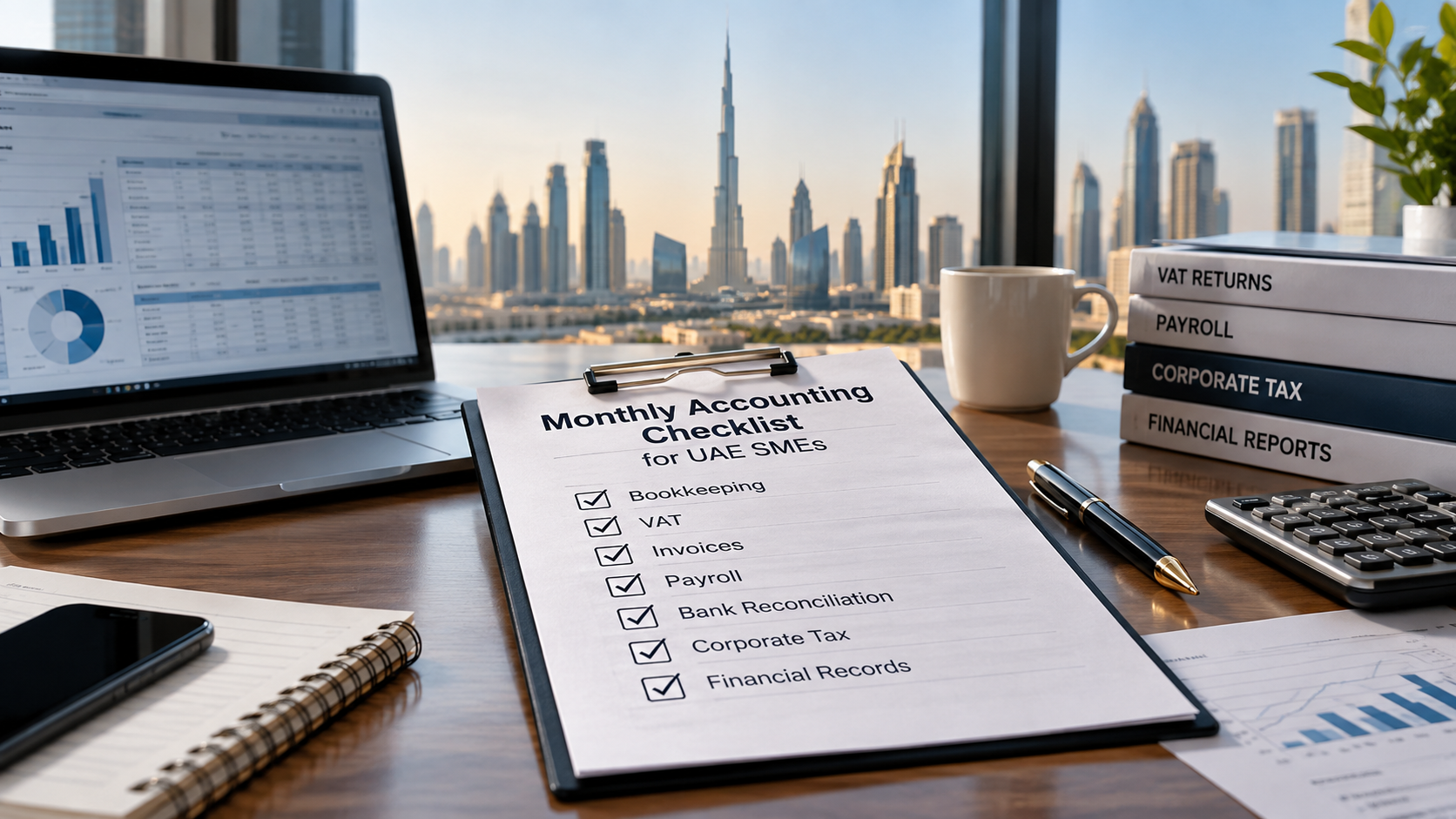
Monthly Accounting Checklist for UAE SMEs
Keep this checklist handy in your monthly closing process for quick reference:
| Task | Monthly Check |
| Sales | Record and review all income. |
| Expenses | Categorise and verify supporting documents. |
| Bank | Reconcile all bank accounts. |
| Receivables | Review overdue customer invoices. |
| Payables | Check supplier balances and upcoming payments. |
| VAT | Review VAT transactions and records. |
| Payroll | Verify salary and employee-related entries. |
| Assets | Record major purchases correctly. |
| Corporate Tax | Maintain relevant accounting and tax records. |
| Invoicing | Organise invoices and review eInvoicing readiness |
| Reports | Review P&L, balance sheet and cash-flow information. |
| Final Review | Investigate unusual or incomplete transactions. |
Frequently Asked Questions
An SME should review sales, expenses, bank reconciliation, receivables, payables, payroll, VAT records, major purchases, tax records and monthly financial reports.
Regular bookkeeping keeps financial records current, makes tax preparation easier and gives business owners timely information about profitability, cash flow and outstanding payments.
In the UAE, businesses must maintain appropriate financial and commercial records. VAT obligations also require businesses to maintain relevant records, while corporate tax calculations depend on accounting information and supporting records.
VAT records should be maintained continuously, with a monthly review helping identify missing invoices, incorrect classifications and documentation issues before the relevant VAT filing process.
No. The UAE Ministry of Finance specifically distinguishes structured electronic invoices from PDFs, Word documents, images, scans and email attachments.
An SME can consider internal audit work when it wants to review financial controls, identify process weaknesses, reduce operational risks or strengthen its internal accounting procedures.
Final Thoughts
Accounting doesn’t have to become a month-end scramble.
For UAE SMEs, a simple monthly routine can keep financial information organised throughout the year and make VAT, Corporate Tax, reporting and audit preparation much easier.
The key is consistency. Recording transactions once a month is easier than trying to reconstruct an entire quarter. Reviewing receivables regularly is more useful than discovering overdue invoices months later. Keeping tax and invoice records organised also gives the business a much stronger financial foundation.
If managing the accounts internally is taking too much time, professional Accounting and Bookkeeping Services in Dubai can help SMEs maintain their records, review financial information and stay organised as the business grows.
Irtiqa Al Falah provides accounting, bookkeeping, VAT, corporate tax and audit-related support for businesses in Dubai and across the UAE.