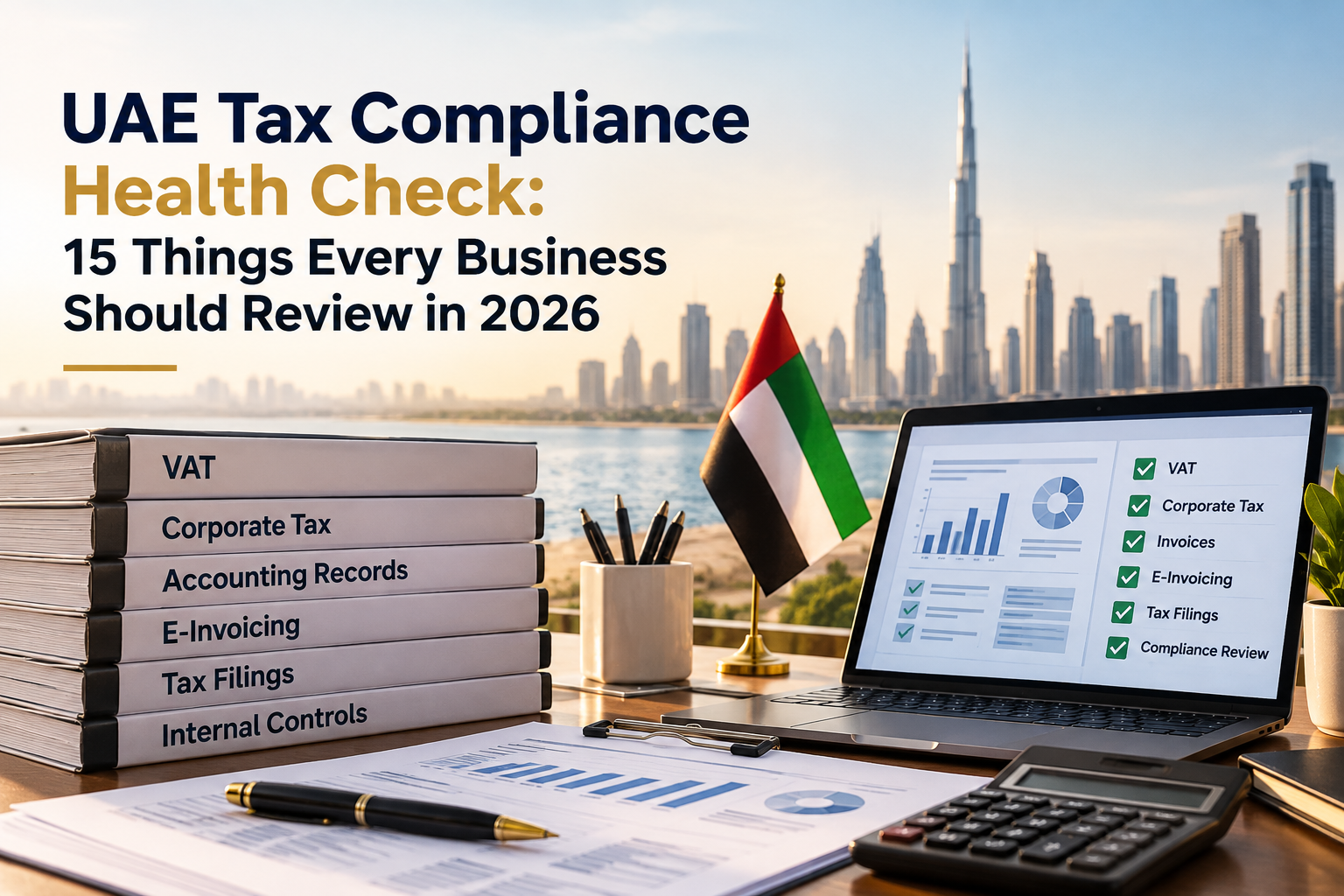
UAE Tax Compliance Health Check: 15 Things Every Business Should Review in 2026
Tax compliance is rarely something a business should think about only when a filing deadline is approaching.
For UAE businesses, keeping accounting records accurate, understanding VAT responsibilities, maintaining corporate tax information and preparing for changes such as e-invoicing are all part of an ongoing compliance process.
This is particularly important in 2026 because the UAE’s tax framework continues to develop. The Federal Tax Authority and Ministry of Finance have issued new legislation and guidance during the year, including updates affecting VAT, Corporate Tax, accounting records and electronic invoicing.A regular tax health check can help businesses identify gaps before they turn into expensive or time-consuming problems.
Here are 15 areas every UAE business should review in 2026.
1. Confirm Your Tax Registration Status
Start with the basics.
Check whether your business is correctly registered for the taxes that apply to its activities.
For VAT, UAE-resident businesses generally have a mandatory registration threshold of AED 375,000 in taxable supplies and imports over the previous 12 months, or where that threshold is expected to be exceeded in the next 30 days. The voluntary registration threshold is AED 187,500, subject to the applicable conditions.
Businesses should periodically review their turnover and taxable activities rather than assuming their previous registration position will always remain appropriate.
2. Check Your VAT Registration Details
Being VAT-registered is only the first step.
Review whether the information connected with your VAT registration remains accurate, including:
- Legal business name
- Business activities
- Contact information
- Registered address
- Bank details where relevant
- Tax Registration Number
- Branch information
If there have been changes to the business, check whether an update or notification is required.
For businesses that need professional support, VAT Consultancy Services in Dubai can form part of a broader compliance review.
3. Review Your VAT Returns and Supporting Records
VAT records should not simply be prepared immediately before the filing deadline.
Review previous VAT returns against your accounting records and supporting documents.
Look for:
- Missing tax invoices
- Incorrect VAT treatment
- Unusual input VAT claims
- Credit notes
- Output VAT differences
- Transactions recorded in the wrong period
The FTA states that VAT-registered businesses must file VAT returns and make related payments within 28 days from the end of their tax period.
A regular review can make the filing process considerably smoother.
4. Check Whether Your Tax Invoices Are Correct
A tax invoice is more than a sales document.
Review whether invoices contain the information required under the applicable VAT rules and whether your accounting system is applying the correct VAT treatment.
Check:
- Customer details
- Supplier details
- TRN information
- Invoice dates
- Invoice numbers
- Taxable amounts
- VAT amounts
- Applicable VAT treatment
The FTA continues to publish VAT guides and public clarifications, so businesses should check current official guidance when dealing with specific or unusual transactions.
5. Review Your Corporate Tax Registration
Corporate Tax compliance should be part of the company’s regular financial review.
The UAE corporate tax regime applies to taxable individuals within its scope, including UAE juridical persons and certain other businesses. The Ministry of Finance states that taxable persons are required to register for corporate tax and obtain a corporate tax registration number, subject to the applicable rules and exceptions.
Review whether:
- Your business is registered
- Registration information is correct
- Your tax period is understood
- Your filing deadline is documented
- Your accounting records support the tax calculation
If you are unsure about your position, professional Tax Consultancy Services in Dubai can help review the business’s tax obligations.
6. Review Your Corporate Tax Filing Timeline
Don’t wait for the filing deadline to discover that financial information is incomplete.
The Ministry of Finance states that Corporate Tax returns are generally due within nine months from the end of the relevant Tax Period, with the same general timeframe applying to payment of Corporate Tax due.
Businesses should therefore maintain an internal compliance calendar showing:
- Tax period
- Registration status
- Return due date
- Payment due date
- Required supporting information
- Responsible team member or advisor
7. Make Sure Your Accounting Records Are Complete
Tax compliance starts with reliable accounting.
The Ministry of Finance states that businesses in the UAE need to record financial transactions and maintain accurate, up-to-date financial records.
Review whether your records include:
- Sales
- Purchases
- Expenses
- Bank transactions
- Receivables
- Payables
- Assets
- Liabilities
- Supporting invoices and documents
Professional accounting services in Dubai can help businesses maintain consistent accounting records rather than trying to reconstruct them when tax work is due.
8. Reconcile Your Bank Accounts
Bank reconciliation is a simple control that can reveal accounting problems quickly.
Compare your accounting records with your bank statements and investigate:
- Unrecorded payments
- Missing receipts
- Duplicate entries
- Bank charges
- Unidentified transactions
- Transfers between accounts
If your financial records do not match the bank, understand why before finalising tax calculations.
9. Review Your Business Expenses
Not every expense should automatically be treated the same way for tax purposes.
Review large or unusual expenses and confirm that they have appropriate supporting documentation and have been classified correctly.
Pay particular attention to:
- Entertainment-related expenses
- Personal and business expenses
- Large purchases
- Related-party transactions
- Overseas expenses
- One-off payments
Keeping a clear audit trail makes future tax reviews easier.
10. Check Your Corporate Tax Accounting Adjustments
Corporate Tax calculations generally start with accounting income and then require relevant adjustments to determine taxable income.
The Ministry of Finance specifically explains that accounting income is the starting point and that adjustments may be required for items such as exempt income or expenditure that is wholly or partially non-deductible.This means your accounting records should be maintained with tax considerations in mind.
If your business has complex transactions, a Tax Consultant in Dubai can review the relevant treatment rather than relying on assumptions.
11. Review Related-Party Transactions
Businesses should identify transactions involving related parties and connected persons where the Corporate Tax rules may require specific treatment or documentation.
Examples can include:
- Management fees
- Loans
- Payments between related companies
- Shared services
- Asset transfers
These transactions deserve particular attention because their tax treatment may differ from ordinary third-party transactions.
Maintain contracts, invoices, calculations and other relevant documentation.
12. Review Your Internal Financial Controls
Tax compliance is not only about filing returns.
It is also about how financial information moves through the business.
Ask:
- Who approves expenses?
- Who creates invoices?
- Who records transactions?
- Who approves payments?
- Who reconciles bank accounts?
- Who reviews tax returns?
- Are duties appropriately separated?
An Internal Audit Services in Dubai review can help businesses identify weaknesses in financial processes and controls.
For growing SMEs, this can be particularly useful when accounting responsibilities are shared between multiple employees.
13. Check Your Records Are Audit-Ready
Imagine receiving a request for supporting documents tomorrow.
Could your business quickly produce:
- Sales invoices
- Purchase invoices
- Bank statements
- Contracts
- Expense records
- VAT records
- Tax filings
- Accounting reports
- Supporting calculations
If the answer is no, the business may have a record-management problem.
Good compliance means maintaining an organised audit trail throughout the year, not creating one after receiving a request.
14. Review Your eInvoicing Readiness
Electronic invoicing is an important compliance area to monitor in 2026.
The Ministry of Finance defines an eInvoice as structured invoice data issued and exchanged electronically and reported electronically to the UAE Federal Tax Authority. A PDF, Word document, image, scanned invoice or email attachment by itself is not considered an eInvoice. The UAE has also continued issuing 2026 decisions affecting the electronic invoicing framework and service-provider requirements.
Businesses should therefore review:
- Accounting software
- Invoice workflows
- Customer and supplier data
- Structured invoice capabilities
- Data storage
- Integration requirements
- Readiness for applicable implementation timelines
Businesses planning their transition can explore e-invoicing services in Dubai as part of their broader compliance planning.
15. Review Your Overall Tax Compliance Calendar
Finally, put everything into one place.
Your 2026 compliance calendar should identify relevant:
- VAT filing dates
- VAT payment dates
- Corporate Tax deadlines
- Registration deadlines
- Record-keeping tasks
- eInvoicing milestones
- Internal reviews
- Accounting closing dates
This simple step can prevent deadlines from being managed separately by different people.
The FTA continues to update its legislation, guides and public clarifications, so businesses should use current official sources when checking tax obligations.
UAE Tax Compliance Health Check: Quick Checklist
| Compliance Area | What to Review |
| Tax Registration | Confirm applicable registrations |
| VAT Registration | Check details and status |
| VAT Returns | Review filings and supporting records |
| Tax Invoices | Check required information |
| Corporate Tax | Confirm registration and obligations |
| CT Filing | Record applicable deadlines |
| Accounting Records | Keep books accurate and complete |
| Bank Reconciliation | Match accounts with statements |
| Expenses | Review classification and documents |
| CT Adjustments | Review taxable-income calculations |
| Related Parties | Identify relevant transactions |
| Internal Controls | Check approvals and processes |
| Records | Maintain an audit-ready trail |
| eInvoicing | Review system readiness |
| Compliance Calendar | Track all applicable deadlines |
Why a Tax Health Check Matters for UAE Businesses
Tax compliance is easier to manage when it becomes part of normal business operations.
Instead of waiting for a VAT filing, Corporate Tax return or audit request, businesses can periodically review their records and identify gaps while the information is still easy to find.
A proper health check can help businesses:
- Find missing documents
- Improve bookkeeping accuracy
- Identify potential compliance gaps
- Prepare for tax filings
- Strengthen financial controls
- Improve audit readiness
- Prepare for e-invoicing
- Make tax-related decisions with better information
It is also worth remembering that tax rules and official guidance can change. The FTA’s 2026 legislation database already shows multiple new or amended tax decisions issued during the year.
Frequently Asked Questions
A tax compliance health check is a structured review of a business’s tax registrations, accounting records, VAT processes, Corporate Tax obligations, invoices, documentation and internal controls.
Businesses should review VAT registration and records, Corporate Tax registration and filing requirements, accounting records, tax invoices, supporting documentation, internal controls and eInvoicing readiness.
No. VAT registration depends on the applicable rules and thresholds. For UAE-resident businesses, the mandatory registration threshold is generally AED 375,000 of taxable supplies and imports over the relevant 12-month period or expected within the next 30 days.
There is no single review frequency that fits every business. A monthly or quarterly internal review can help keep records current, while a more detailed annual health check can assess the overall compliance position.
Corporate Tax compliance can include registration, maintaining appropriate accounting and tax records, determining taxable income, filing the Corporate Tax return and paying any tax due within the applicable deadlines.
Corporate Tax compliance can include registration, maintaining appropriate accounting and tax records, determining taxable income, filing the Corporate Tax return and paying any tax due within the applicable deadlines.
No. According to the Ministry of Finance, PDFs, Word documents, images, scans and email attachments are not eInvoices by themselves. An eInvoice uses structured invoice data that is exchanged electronically through the applicable framework.
Final Thoughts
A tax compliance review does not have to be complicated.
For most UAE businesses, the process starts with something quite practical: accurate books, organised documents and a clear understanding of applicable tax obligations.
In 2026, businesses should also keep an eye on developments in VAT, Corporate Tax, accounting-record requirements and eInvoicing rather than relying on outdated processes.
If your business is unsure whether its accounting, VAT or Corporate Tax processes are properly organised, professional Tax Consulting Services in Dubai and accounting support can help identify areas that require attention.
Irtiqa Al Falah can support UAE businesses with accounting, bookkeeping, tax and audit-related requirements through a structured approach to financial compliance.
For businesses that want to strengthen their 2026 tax position, a proactive review is often much easier than trying to fix several issues at the filing deadline.