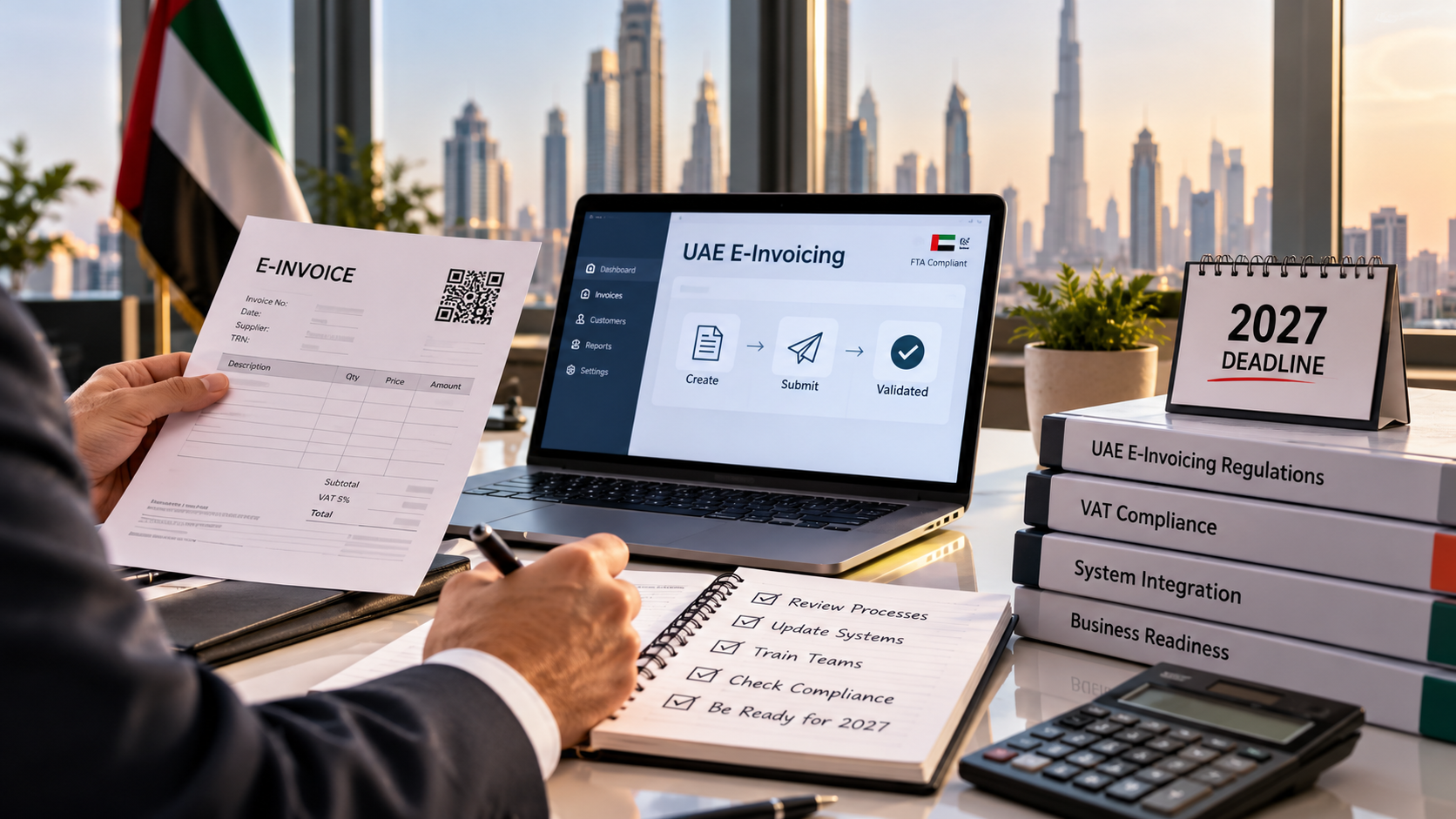
The UAE tax landscape is still evolving with several key changes impacting corporate tax, VAT, e-invoicing, tax procedures, free zone businesses, multinational groups and small businesses in 2026.
For UAE businesses, staying updated is no longer just about filing tax returns on time. Businesses also need to be aware of changes in tax procedures, digital invoicing, VAT documentation, corporate tax reliefs and international tax requirements.
The UAE introduced and clarified several important tax measures in 2026. Some are intended to make it easier for businesses to comply, while others introduce additional reporting, documentation or digital requirements.
This guide discusses 7 key UAE tax changes for 2026 and what they could mean for businesses operating in Dubai and across the UAE.
UAE Tax Changes 2026: Quick Overview
Here are the seven key developments businesses should know:
- Small Business Relief extended until 31 December 2029
- New UAE e-invoicing requirements and implementation deadlines
- VAT law amendments effective from January 2026
- New tax procedures, rules and compliance changes
- New Pillar Two filing requirements for multinational enterprises
- Additional compliance procedures for Qualifying Free Zone Persons
- New R&D Tax Incentives Programme for qualifying businesses
Each change affects a different part of the UAE tax environment, so businesses should assess which rules apply to their specific circumstances.
1. UAE Small Business Relief Extended Until 2029
One of the biggest recent developments for SMEs is the extension of UAE Small Business Relief.
In August 2026, the UAE Ministry of Finance announced that the Small Business Relief threshold will continue to apply for eligible tax periods ending on or before 31 December 2029.
The relevant revenue threshold continues to be AED 3 million, subject to applicable conditions.
What does this mean for small businesses?
Eligible businesses with annual revenue not exceeding AED 3 million may be able to benefit from Small Business Relief and simplified corporate tax compliance requirements.
However, having revenue below AED 3 million does not automatically mean that every business qualifies.
Businesses must consider:
- UAE tax residency
- Current tax period revenue
- Relevant previous tax period revenue
- Business structure
- Free Zone status
- Multinational group status
- Other applicable eligibility conditions
- The required election for the relevant tax period
Who should pay attention?
This update is particularly relevant to:
- Startups
- SMEs
- Individual entrepreneurs
- Small UAE companies
- Growing businesses
- Family-owned businesses
- Professional service businesses
For small businesses, accurate accounting and bookkeeping remain important because revenue must be monitored properly.
Practical tip
Do not wait until the end of the tax period to determine whether your business is approaching the AED 3 million threshold.
Regular financial reporting can help business owners monitor revenue and plan their corporate tax position more effectively.
2. UAE E-Invoicing Is Moving Into Mandatory Implementation
UAE e-Invoicing 2026–2027 is another major development businesses need to prepare for.
The UAE is introducing a structured electronic invoicing system under which businesses within scope will issue, exchange and report invoice data electronically.
Importantly, a PDF invoice sent by email is not the same as a structured eInvoice.
The UAE e-invoicing framework is based on an electronic exchange model using accredited service providers.
Important UAE e-Invoicing deadlines
For businesses with annual revenue of AED 50 million or more, the mandatory implementation date remains:
1 January 2027
The deadline for appointing an accredited service provider for this group has been extended to:
30 October 2026
Businesses with annual revenue below AED 50 million have a later mandatory implementation date of:
1 July 2027
The applicable ASP appointment deadline for this group is:
31 March 2027
Why should businesses prepare early?
E-invoicing may require changes to:
- Accounting software
- ERP systems
- Invoice workflows
- Customer data
- Supplier data
- VAT information
- Finance processes
- Internal controls
- Employee responsibilities
Businesses looking for e-invoicing services in Dubai should therefore think beyond simply purchasing software.
The objective should be to build an e-invoicing process that works with the company’s wider accounting and tax system.
Benefits of e-Invoicing
For businesses, e-invoicing can support:
- Faster invoice processing
- Better financial data
- Reduced manual errors
- Improved cash-flow visibility
- Better tax compliance
- Digital recordkeeping
- Accounting automation
- More efficient invoice exchange
For SMEs, the transition may also be an opportunity to modernise accounting and bookkeeping processes.
3. Important UAE VAT Changes Took Effect in 2026
Several VAT-related changes became effective from 1 January 2026.
These amendments are important because they affect how certain businesses handle VAT documentation, refunds and input-tax deductions.
Reverse charge self-invoicing changes
Under the amended VAT framework, taxable individuals applying the reverse charge mechanism are relieved from issuing self-invoices in the relevant circumstances.
However, businesses still need to retain supporting documents relating to the relevant transactions.
This means businesses should not interpret the change as removing their documentation responsibilities.
VAT refund time limit
The amendments also introduced a five-year time limit for submitting requests to reclaim excess refundable tax after reconciliation has taken place.
Businesses should therefore review outstanding VAT balances rather than allowing old refundable amounts to remain unresolved indefinitely.
Input tax and tax-evasion arrangements
The amendments also strengthen the FTA’s ability to deny input-tax deduction where a supply forms part of a tax-evasion arrangement.
This places greater importance on businesses checking the legitimacy and integrity of transactions before claiming input VAT.
What should businesses do?
Businesses should review:
- VAT documentation
- Supplier records
- Purchase invoices
- Reverse-charge transactions
- VAT refund balances
- Input VAT claims
- Internal VAT controls
For businesses using VAT Consultancy Services in the UAE or VAT Consultancy Services in Dubai, 2026 is a good time to review existing VAT processes.
4. UAE Tax Procedures Have Been Updated
Another important development in 2026 concerns the UAE’s Tax Procedures framework.
Amendments to the Tax Procedures Executive Regulation became effective from 1 April 2026.
The changes include updates relating to voluntary disclosures, tax refunds, record retention and procedures connected with tax audits and examinations.
What changed?
The amendments clarify procedures relating to:
- Voluntary disclosures
- Refunds
- Taxpayer credit balances
- Record retention
- Disclosure to competent authorities
- Tax audits
- Examination procedures
- Preservation or seizure of documents and assets
Why does this matter?
Tax compliance is not limited to submitting a return.
Businesses need to maintain reliable financial records that can support their:
- VAT returns
- Corporate tax returns
- Refund applications
- Voluntary disclosures
- Accounting records
- Tax positions
Recordkeeping is becoming more important.
Businesses should ensure that financial records are:
- Accurate
- Complete
- Organised
- Easily retrievable
- Consistent with accounting records
- Supported by appropriate documentation
Professional accounting services in Dubai and Dubai bookkeeping can help businesses establish stronger financial recordkeeping systems.
5. New Pillar Two Filing Requirements for Multinational Groups
International businesses should pay particular attention to the UAE’s implementation of Pillar Two.
In August 2026, the UAE Ministry of Finance issued Ministerial Decision No. 133 of 2026, which sets out entities required to file the Pillar Two Information Return.
The rules form part of the UAE’s implementation of the OECD/G20 Global Anti-Base Erosion (GloBE) Rules.
Who may be affected?
The decision covers certain UAE entities connected with multinational enterprise groups, including:
- UAE Constituent Entities
- Certain Joint Ventures
- Joint Venture Subsidiaries
- Certain stateless constituent entities
The requirements apply to relevant fiscal years starting on or after 1 January 2025.
Why is Pillar Two important?
Pillar Two is designed to establish a global minimum tax framework for large multinational enterprise groups.
It is therefore particularly relevant to:
- Multinational groups
- UAE subsidiaries of international companies
- Large corporate groups
- Finance departments
- International tax teams
- Tax advisers
Small local businesses that are not part of a relevant multinational group generally do not face these specific reporting requirements.
What should multinational businesses do?
Affected groups should review:
- Group structure
- UAE entities
- Fiscal-year dates
- Consolidated group revenue
- Pillar Two obligations
- Information-return requirements
- Internal reporting processes
For complex cases, professional tax consulting firms in Dubai can help businesses assess their international tax compliance responsibilities.
6. New Compliance Procedures for Qualifying Free Zone Persons
Free Zone businesses should not assume that a Free Zone licence automatically means zero corporate tax.
A Qualifying Free Zone Person (QFZP) must meet the relevant requirements to benefit from the applicable 0% Corporate Tax treatment on Qualifying Income.
In 2026, the Federal Tax Authority issued FTA Decision No. 6 of 2026, providing additional procedures concerning QFZP compliance.
Why is this decision important?
Free Zone businesses need to pay attention to areas such as:
- Qualifying Income
- Accounting records
- Corporate tax compliance
- Financial reporting
- Relevant conditions
- Supporting documentation
A business should assess its actual tax position instead of assuming that its free zone status alone guarantees a 0% corporate tax rate.
What should Free Zone businesses do?
Businesses should:
- Review their corporate tax status
- Understand whether they qualify as a QFZP
- Review their sources of income
- Maintain proper accounting records
- Monitor applicable conditions
- Review compliance requirements regularly
This situation is another reason why reliable accounting firms in Business Bay Dubai, accounting professionals and tax advisers can be valuable for growing Free Zone businesses.
7. UAE Introduces an R&D Tax Incentives Programme
The UAE has also introduced a new Research and Development Tax Incentives Programme to encourage private-sector investment in research and innovation.
Under Phase 1 of the programme, qualifying businesses may benefit from a non-refundable R&D tax credit of up to 50% on qualifying expenditure of up to AED 5 million, subject to the applicable conditions.
Why is this amount significant?
The incentive is designed to encourage companies to invest in:
- Research
- Innovation
- Technology
- Product development
- Advanced industries
- New business solutions
It also reflects the UAE’s broader focus on developing a knowledge-based and innovation-driven economy.
Which businesses may benefit?
The opportunity may be particularly relevant to businesses involved in:
- Technology
- Software
- Engineering
- Advanced manufacturing
- Research
- Product development
- Innovation
- Emerging technologies
Businesses should carefully assess whether their expenditure meets the definition of qualifying R&D expenditure before assuming that it qualifies for the incentive.
Practical advice
Businesses investing heavily in R&D should maintain:
- Project documentation
- Expenditure records
- Employee records
- Development records
- Technical documentation
- Supporting invoices
- Accounting records
Good documentation will be important when determining whether expenditure meets the applicable requirements.
UAE Tax Changes 2026: What Businesses Should Do Now
The 2026 tax updates show a clear direction in UAE tax administration:
More digitalisation + stronger documentation + clearer compliance + greater international alignment.
Businesses should therefore take a proactive approach.
1. Review your corporate tax position.
Check whether your business:
- Is registered for corporate tax
- Has filed the required returns
- Qualifies for Small Business Relief
- Operates in a Free Zone
- May be affected by QFZP rules
2. Review your VAT processes.
Check:
- Input VAT claims
- Reverse-charge transactions
- VAT refund balances
- Supporting documents
- Supplier information
- Tax invoices
3. Prepare for e-Invoicing
Do not wait until the final implementation deadline.
Start reviewing:
- Accounting software
- ERP compatibility
- Invoice workflows
- Customer master data
- Supplier data
- VAT data
- Accredited Service Providers
Businesses searching for E-Invoicing Services, E-Invoicing Services in Dubai, E-Invoicing Services in Dubai Marina, E-Invoicing Services in Jumeirah, E-Invoicing Services in Palm Jumeirah, or E-Invoicing Services in JLT should prioritise regulatory and technical expertise rather than choosing a provider only because it is nearby.
4. Strengthen bookkeeping
Good bookkeeping is the foundation of tax compliance.
Businesses should regularly reconcile:
- Bank accounts
- Sales
- Purchases
- Expenses
- Receivables
- Payables
- VAT
- Corporate tax records
Professional Bookkeeping Services in Business Bay, Bookkeeping Services in Jumeirah, Bookkeeping Services in Palm Jumeirah, or other Dubai locations can help businesses maintain consistent financial records.
5. Review your Free Zone status.
If your company operates from a UAE Free Zone, check whether you meet the conditions required for QFZP treatment.
Do not assume that every Free Zone company automatically receives 0% corporate tax.
6. Check whether Pillar Two applies.
If your company is part of a large multinational group, review the new Pillar Two reporting requirements.
This should be handled at the group level because the relevant obligations depend on the group’s structure and circumstances.
7. Monitor official UAE tax announcements.
UAE tax legislation continues to evolve.
Businesses should regularly check updates from:
- UAE Ministry of Finance
- Federal Tax Authority
- Relevant legislation
- Official tax guidance
This information is especially important for businesses operating in regulated or rapidly changing sectors.
How 2026 UAE Tax Changes Affect SMEs
Small and medium businesses may not experience all seven developments equally.
For many SMEs, the most relevant areas are likely to be:
Corporate Tax
Small Business Relief has been extended through 2029, subject to the applicable conditions.
VAT
VAT documentation and refund procedures have changed, requiring businesses to review their processes.
E-Invoicing
Businesses need to prepare for phased mandatory implementation.
Accounting
Accurate financial records are increasingly important for demonstrating tax compliance.
Bookkeeping
Regular bookkeeping can help businesses monitor revenue, VAT and corporate tax obligations.
UAE Tax Changes 2026 for Dubai Businesses
Dubai businesses are subject to the same federal UAE tax framework as businesses operating elsewhere in the country.
Whether a business operates in:
- Business Bay
- Downtown Dubai
- Dubai Marina
- Jumeirah
- Palm Jumeirah
- JLT
- Al Qusais
The applicable federal tax legislation remains the key reference point.
Businesses searching for accounting firms near me, accounting services near me, or tax consultants in Dubai, tax consultancy in Dubai, or tax consulting firms in Dubai should therefore look for professionals who understand the UAE-wide regulatory framework.
Why Professional Accounting and Tax Support Matters in 2026
The UAE tax environment is becoming more interconnected.
A business’s accounting records can affect its:
VAT → Corporate Tax → E-Invoicing → Financial Reporting → Audit Readiness → Tax Compliance
This means tax compliance should not be treated as a collection of separate tasks.
For example, accurate bookkeeping supports reliable VAT reporting, Corporate Tax calculations and e-invoicing data.
Similarly, effective internal controls can help identify errors before they become compliance problems.
Businesses may therefore benefit from integrated support covering:
- Accounting
- Bookkeeping
- VAT
- Corporate Tax
- Tax consultancy
- E-Invoicing
- Audit
- Internal audit
Frequently Asked Questions About UAE Tax Changes 2026
What are the major UAE tax changes in 2026?
Major developments include the extension of Small Business Relief, the rollout of e-Invoicing, VAT amendments, Tax Procedures updates, new Pillar Two filing requirements, additional QFZP compliance procedures and the R&D Tax Incentives Programme.
Is Small Business Relief available in 2026?
Eligible businesses meeting the applicable conditions can benefit from Small Business Relief, and the AED 3 million threshold has been extended to Tax Periods ending on or before 31 December 2029.
What is the UAE e-invoicing deadline?
For businesses with annual revenue of AED 50 million or more, mandatory implementation remains 1 January 2027. Businesses with revenue below AED 50 million have a later implementation date of 1 July 2027.
Did UAE VAT rules change in 2026?
Yes. VAT law amendments became effective from 1 January 2026, including changes relating to reverse-charge self-invoicing, VAT refunds and input-tax deductions in certain tax-evasion situations.
What changed in UAE Tax Procedures in 2026?
Changes effective from April 2026 include updates concerning voluntary disclosures, refunds, record retention and certain tax audit and examination procedures.
Do Free Zone companies pay Corporate Tax in the UAE?
Free Zone companies are within the UAE corporate tax framework. A qualifying free zone person may benefit from a 0% rate on qualifying income if the applicable conditions are met. Free Zone status alone does not automatically guarantee 0% corporate tax.
Who needs to worry about Pillar Two in the UAE?
Pillar Two primarily concerns qualifying multinational enterprise groups and their relevant constituent entities. The exact filing obligations depend on the group’s circumstances and the applicable rules.
What is the UAE R&D Tax Incentive?
The UAE’s R&D Tax Incentives Programme provides a non-refundable tax credit of up to 50% on qualifying expenditure of up to AED 5 million under Phase 1, subject to the programme’s conditions.
Does every UAE business need an e-Invoice?
The UAE e-invoicing system is being introduced in phases and applies to transactions and persons within the scope of the applicable legislation, subject to exclusions.
UAE Tax Compliance Checklist for 2026
Before the end of the year, businesses should consider the following:
- Review corporate tax registration
- Check Small Business Relief eligibility
- Review the AED 3 million revenue threshold where applicable
- Review Free Zone Corporate Tax status
- Check QFZP compliance requirements
- Review VAT procedures
- Check outstanding VAT refund balances
- Review input VAT documentation
- Prepare for e-Invoicing
- Review accounting software compatibility
- Evaluate accredited service provider requirements
- Improve bookkeeping and financial records
- Check whether Pillar Two applies
- Review potential R&D tax incentives
- Keep tax and accounting documents organised
- Monitor official FTA and Ministry of Finance updates
Final Thoughts: What UAE Businesses Should Remember in 2026
The UAE tax environment in 2026 is becoming more digital, structured and internationally aligned.
For small businesses, the extension of Small Business Relief provides additional planning certainty.
For businesses of all sizes, the changes to VAT and tax procedures mean that accurate documentation is becoming increasingly important.
For larger businesses, e-invoicing preparation is now an immediate priority.
For Free Zone businesses, maintaining QFZP eligibility requires careful attention to the applicable conditions.
For multinational groups, Pillar Two reporting introduces additional international tax responsibilities.
And for innovative businesses, the new R&D Tax Incentives Programme may create opportunities to support investment in research and development.
The most practical lesson is simple:
Do not wait until a tax deadline arrives to review your compliance.
Regular accounting, accurate bookkeeping, proper documentation and professional tax advice can help businesses understand their obligations before problems arise.
For businesses looking for accounting services in Dubai, bookkeeping services in Business Bay, VAT consultancy services in UAE, tax consultancy services in Dubai, corporate tax support, Audit, internal audit services in Dubai or e-invoicing services in Dubai, Irtiqa Al Falah can support businesses with integrated accounting, tax and compliance services.