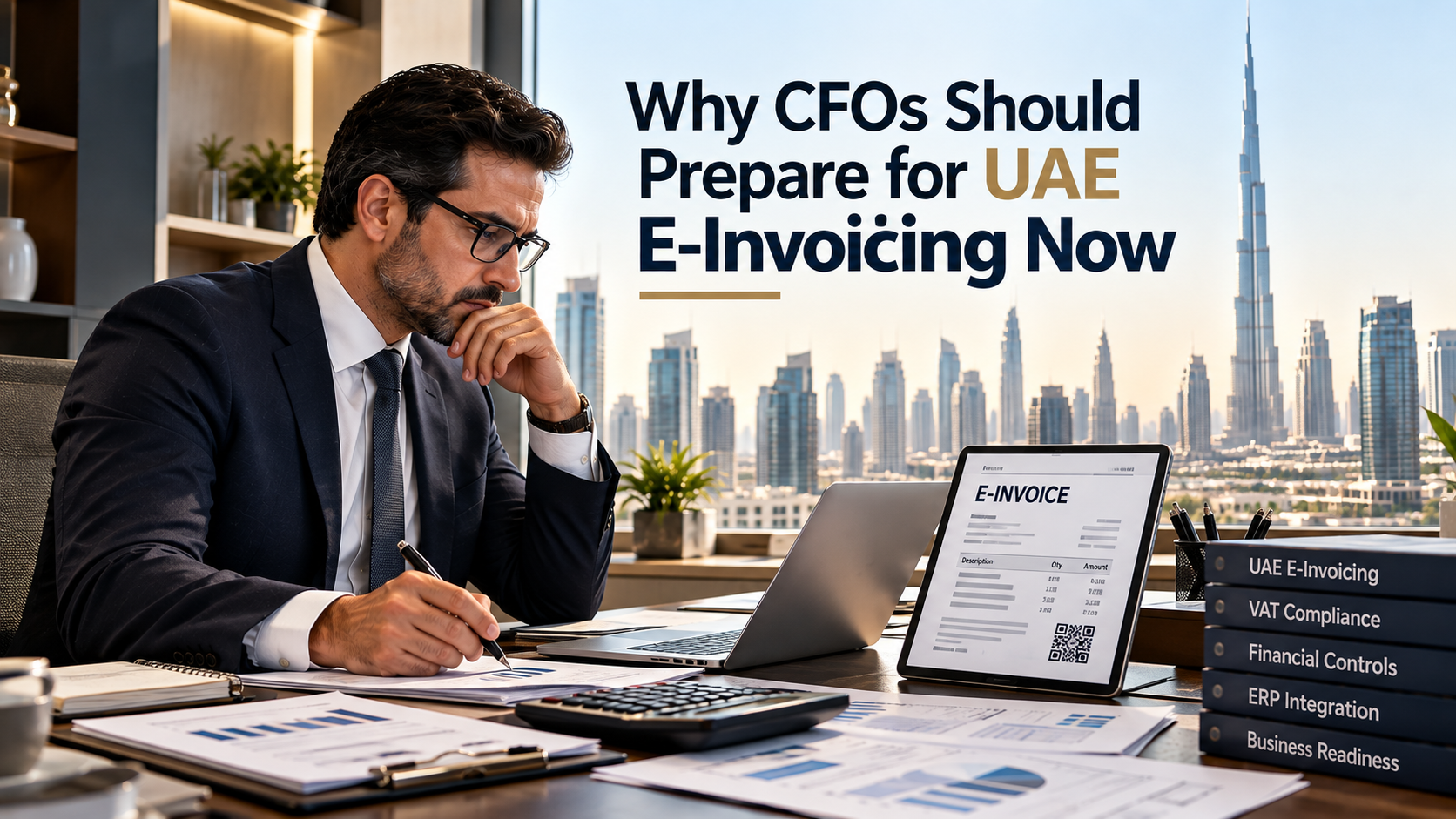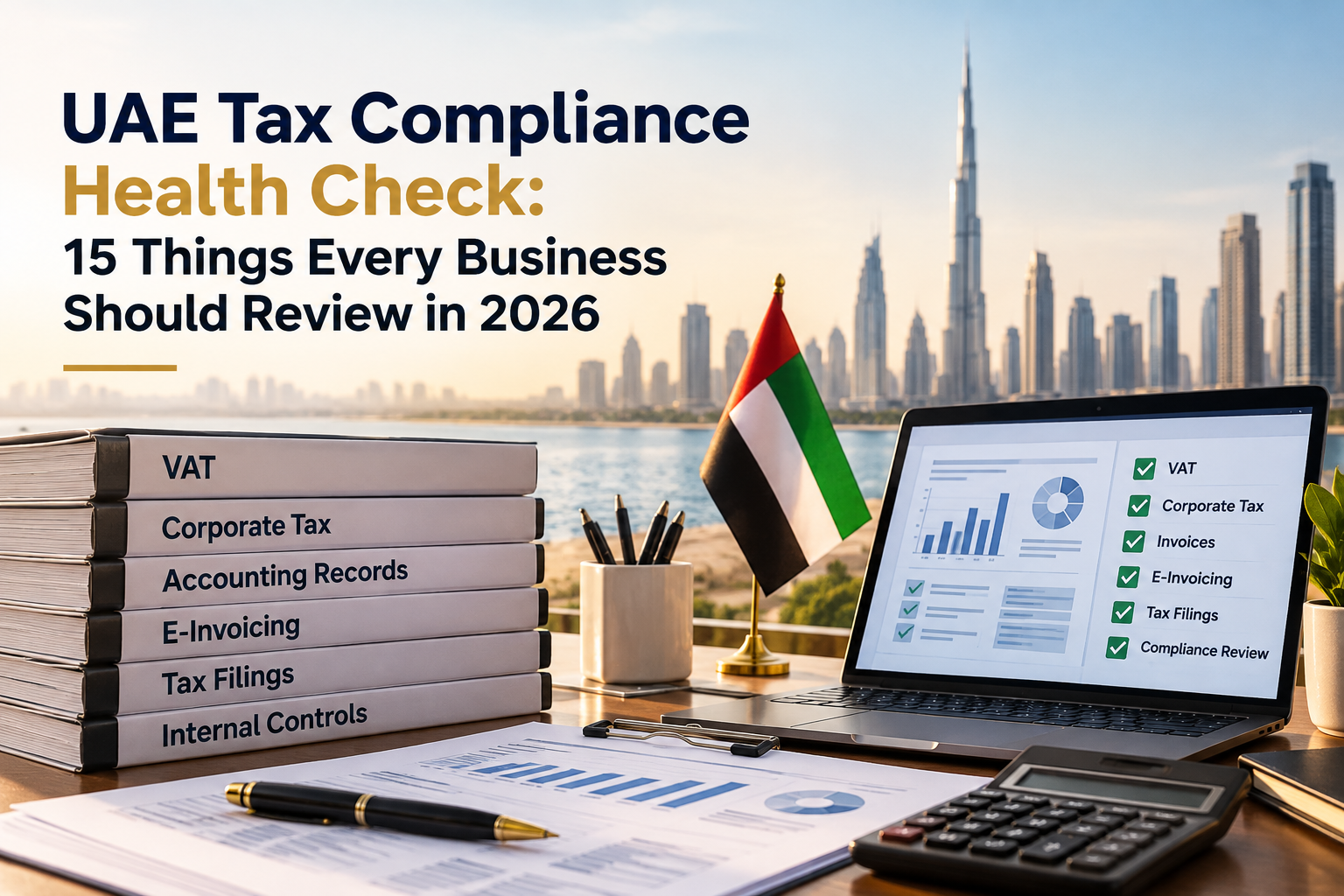
The UAE is moving towards a structured digital invoicing system, making e-invoicing an increasingly important part of financial and tax compliance. For businesses, the transition is not simply about replacing paper invoices with PDFs or sending invoices by email. UAE e-invoicing requires businesses to electronically exchange and report structured invoice data through the applicable framework.
As implementation progresses, businesses that continue relying on incomplete invoice data, outdated accounting systems or manual processes may face avoidable operational and compliance challenges.
This guide explains the common e-invoicing mistakes businesses should avoid in the UAE, how these errors can affect accounting and VAT processes, and what companies can do to prepare for the upcoming requirements.
What Is E-Invoicing in the UAE?
E-invoicing is the electronic issuing and exchange of structured invoice data between a supplier and buyer, with reporting through the UAE e-invoicing framework.
An important point for businesses is that a PDF, scanned invoice, Word document, image or invoice sent as an email attachment is not automatically considered an e-invoice under the UAE framework.
The UAE system is designed around structured electronic data and accredited channels, which means businesses need to consider their accounting software, ERP systems, invoice data and internal processes together.
For businesses looking for professional e-invoicing services, Irtiqa Al Falah provides support for e-invoicing implementation, invoice validation, system integration and compliance preparation. Explore E-Invoicing Services in Dubai.
10 Common E-Invoicing Mistakes Businesses Should Avoid
1. Treating a PDF as a Compliant E-Invoice
One of the most common misunderstandings is assuming that a digitally created PDF is an e-invoice.
A PDF may be useful as a document, but the UAE’s e-invoicing framework is based on structured invoice data, not simply electronic document formats.
Businesses should therefore assess whether their invoicing solution can generate and exchange the required structured data rather than simply converting paper invoices into PDFs.
2. Entering Incorrect or Incomplete Invoice Data
Incorrect invoice information can create problems during accounting, reconciliation and electronic processing.
The Ministry of Finance’s published mandatory field requirements include information such as:
- Invoice number
- Invoice date
- Invoice type code
- Invoice currency
- Transaction type information
- Supplier details
- Buyer details
- Tax information
- Invoice totals
The exact fields depend on the type and circumstances of the invoice.
Businesses should review their invoice templates and accounting systems to identify missing or inconsistent information before implementation.
3. Ignoring VAT Information
E-invoicing does not replace VAT compliance.
Where VAT applies, businesses still need to ensure that their invoice data and accounting records accurately reflect the relevant tax information.
Common issues include:
- Incorrect VAT treatment
- Wrong tax amount
- Missing tax information
- Incorrect customer TRN
- Mismatch between invoice and accounting records
Professional VAT Consultancy Services in UAE can help businesses review their VAT processes alongside their e-invoicing preparation.
4. Using Outdated Accounting or ERP Systems
An invoicing system that works for traditional accounting may not necessarily be ready for structured e-invoicing.
Businesses should review whether their accounting software or ERP can support:
- Structured invoice data
- Automated tax calculations
- Customer and supplier information
- Electronic invoice exchange
- Data validation
- Integration with the required e-invoicing environment
- Secure record management
The Ministry of Finance’s guidance specifically encourages businesses to prepare their internal enterprise solutions for compatibility with the UAE e-invoicing system.
This is particularly important for businesses that rely on accounting and bookkeeping services in Dubai or operate through multiple accounting platforms.
5. Waiting Until the Deadline to Prepare
Waiting until mandatory implementation is close can create unnecessary pressure.
Businesses may need time to:
- Review their current invoicing process
- Clean customer and supplier data
- Upgrade accounting software
- Select an Accredited Service Provider
- Test integrations
- Train finance teams
- Review internal controls
The UAE e-invoicing rollout is phased. Businesses with annual revenue of AED 50 million or more have a mandatory implementation date of 1 January 2027, while businesses below AED 50 million have a mandatory implementation date of 1 July 2027. The Ministry of Finance extended the ASP appointment deadline for businesses above AED 50 million to 30 October 2026.
Early preparation gives finance teams more time to identify technical and data-related issues.
6. Choosing a Service Provider Without Checking Accreditation
Businesses should not select an e-invoicing provider based only on software features or price.
The UAE framework uses Accredited Service Providers (ASPs), and the Ministry of Finance publishes the list of accredited providers.
When evaluating an ASP, businesses should consider:
- Accreditation status
- Integration capabilities
- ERP compatibility
- Data security
- Support and maintenance
- Scalability
- Implementation requirements
- Business continuity
- Reporting capabilities
The right solution should fit the company’s existing accounting and operational environment.
7. Poor Customer and Supplier Data
Incorrect master data can create problems throughout the invoicing process.
For example, businesses may have:
- Duplicate customer records
- Incorrect legal names
- Outdated addresses
- Incorrect TRNs
- Missing supplier information
- Inconsistent customer identifiers
Before implementing e-invoicing, businesses should conduct a data-cleaning exercise.
This is especially important for companies operating across locations such as Business Bay, Jumeirah, Palm Jumeirah, Dubai Marina, JLT and Downtown Dubai.
Businesses searching for E-Invoicing Services in Business Bay, E-Invoicing Services in Jumeirah, or E-Invoicing Services in Dubai Marina should focus on regulatory and technical capability rather than choosing a provider based only on location.
8. Failing to Validate Invoices Before Submission
Invoice validation should become part of the normal finance workflow.
Before an invoice is processed, businesses should check:
- Invoice number
- Invoice date
- Supplier details
- Customer details
- VAT information
- Line-item values
- Tax calculation
- Total amount
- Currency
- Supporting documentation
Automated validation can help identify errors before invoices move through the wider accounting process.
This also connects e-invoicing with broader Accounting Services in Dubai, bookkeeping and financial-control processes.
9. Not Integrating E-Invoicing With Accounting Processes
E-invoicing should not operate as a completely separate activity from accounting.
Ideally, invoice information should flow through connected processes such as:
Sales → Invoice Generation → Validation → E-Invoice Exchange → Accounting Entry → Reconciliation → Reporting
Poor integration can result in duplicated data entry, inconsistent records and additional manual work.
Businesses should therefore assess their accounting workflows before selecting an implementation approach.
For companies requiring broader financial support, professional Accounting Services in Dubai can help improve bookkeeping, financial reporting and accounting processes alongside e-invoicing preparation.
10. Neglecting Internal Controls and Staff Training
Technology alone does not guarantee accurate e-invoicing.
Finance teams need to understand:
- How invoices are created
- Which information must be entered
- How invoice errors are corrected
- How credit notes are handled
- How customer data is maintained
- Who approves invoices
- How records are retained
- How exceptions are managed
Businesses should document their procedures and train relevant employees before implementation.
This is particularly useful for SMEs that may not have dedicated finance or IT teams.
How E-Invoicing Mistakes Can Affect UAE Businesses
E-invoicing mistakes can have wider consequences than a single incorrect invoice.
They may contribute to:
- Accounting discrepancies
- VAT reporting errors
- Delayed invoice processing
- Payment delays
- Duplicate transactions
- Poor financial visibility
- Reconciliation problems
- Additional manual work
- Compliance risks
A well-designed process can reduce these risks by combining accurate data, automation, validation and appropriate internal controls.
E-Invoicing and VAT: Why Businesses Need Both
E-invoicing and VAT are connected, but they are not the same requirement.
VAT is a tax framework.
E-invoicing is a structured electronic system for issuing, exchanging and reporting invoice data.
Businesses therefore need to manage both areas together.
For example, an invoice may be electronically generated but still contain incorrect VAT information. Similarly, accurate VAT calculations do not automatically mean that the invoice meets the technical requirements of the e-invoicing framework.
This is why businesses may benefit from combining e-invoicing support with professional VAT Consultancy Services in Dubai.
How Businesses Can Prepare for UAE E-Invoicing
A practical preparation plan can be divided into six stages.
Step 1: Review Current Invoicing Processes
Document how invoices are created, approved, sent, recorded and stored.
Step 2: Clean Financial Data
Review customer, supplier, VAT and transaction information for missing or duplicate records.
Step 3: Assess Accounting Software
Check whether your accounting or ERP system can support the required structured data and integration.
Step 4: Evaluate an Accredited Service Provider
Review the Ministry of Finance’s current list of Accredited Service Providers and assess which solution fits your business requirements.
Step 5: Test the System
Before full implementation, test invoice generation, data validation, integration, exchange and accounting workflows.
Step 6: Train Your Finance Team
Make sure employees understand the new workflow and know how to identify and resolve invoice errors.
E-Invoicing Services in Dubai: What Should Businesses Look For?
Businesses looking for e-invoicing services in Dubai should evaluate more than just invoice-generation software.
A suitable service approach should consider:
- UAE e-invoicing requirements
- Accounting and ERP integration
- Invoice validation
- VAT data accuracy
- Customer and supplier data
- Electronic record management
- Internal controls
- Staff training
- Ongoing compliance support
Irtiqa Al Falah provides e-invoicing support for businesses across Dubai, including Business Bay, Jumeirah, Palm Jumeirah, Dubai Marina, Downtown Dubai and JLT. Learn more about E-Invoicing Services in Dubai.
Frequently Asked Questions About E-Invoicing Mistakes
A common mistake is assuming that a PDF or scanned invoice automatically qualifies as an e-invoice. The UAE framework requires structured electronic invoice data rather than simply a digital document.
No. According to the Ministry of Finance, PDFs, Word documents, images, scanned copies and email attachments are not considered e-invoices simply because they are electronic.
Mandatory implementation is being phased. Businesses with annual revenue of AED 50 million or more are scheduled to implement e-invoicing from 1 January 2027, while those below AED 50 million are scheduled to do so from 1 July 2027.
Yes. Businesses below AED 50 million in annual revenue have a later mandatory implementation date, but they should still assess their accounting systems, invoice data and processes in advance.
An Accredited Service Provider, or ASP, is an approved service provider within the UAE’s e-invoicing framework that facilitates the required electronic invoicing processes. The Ministry of Finance maintains a published list of accredited providers.
Final Takeaway
The UAE’s transition to e-invoicing means businesses need to think beyond simply replacing paper invoices with digital documents.
The most important areas to address are invoice data accuracy, VAT information, accounting-system compatibility, customer and supplier data, invoice validation, ERP integration and Accredited Service Provider selection.
Preparing early can give businesses more time to identify data gaps, test their systems and train employees before their applicable mandatory implementation date.
Irtiqa Al Falah can help businesses in Dubai that are seeking professional e-invoicing services, accounting support, and VAT guidance to build a more structured and compliant financial workflow.
Prepare Your Business for UAE E-Invoicing
Avoid invoice errors, VAT issues, and compliance gaps with professional e-invoicing and accounting support from Irtiqa Al Falah.
Get Expert E-Invoicing Support Today
Email: info@irtiqaalfalah.com
Call: +971 4 5705345
WhatsApp: +971 56 733 7438