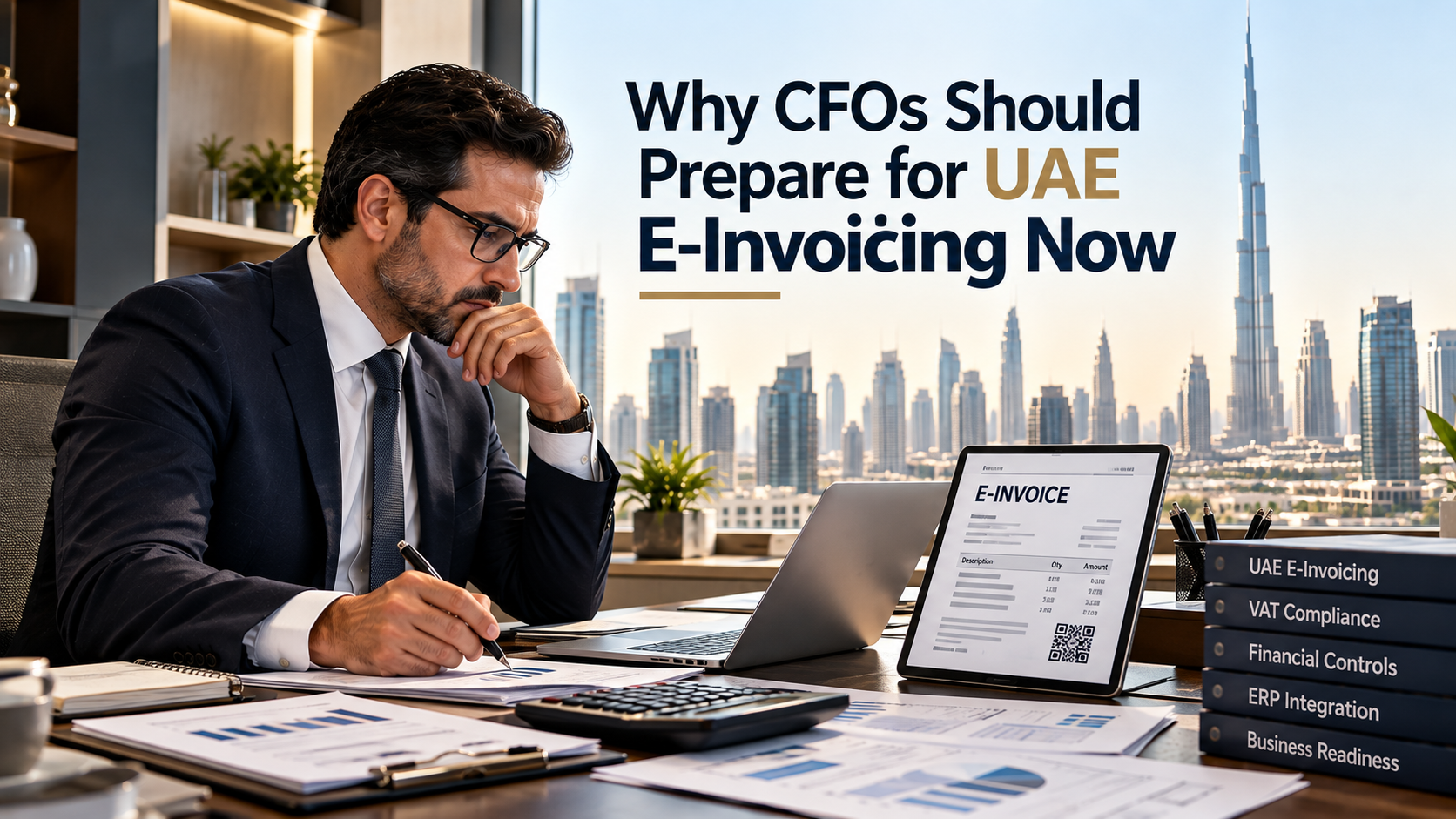
Why CFOs Should Prepare for UAE E-Invoicing Now
UAE e-invoicing is not simply a change from paper invoices to digital documents. For CFOs, it can affect accounting systems, invoicing workflows, VAT data, internal controls, financial reporting, technology integration and finance-team responsibilities.
As the UAE e-invoicing system rolls out in phases, businesses should start preparing well before their applicable implementation deadline. The Federal Tax Authority (FTA) has confirmed that businesses subject to the system with revenue of AED 50 million or more must appoint an accredited service provider by 30 October 2026 and implement e-invoicing by 1 January 2027. Businesses with revenue below AED 50 million have a later deadline to appoint an accredited service provider of 31 March 2027, with implementation required by 1 July 2027.
For CFOs, the key question is therefore not simply, “Is our invoicing software ready?”
The better question is:
“Is our entire finance function ready for structured, connected and compliant electronic invoicing?”
What Is UAE E-Invoicing?
The UAE e-invoicing framework involves structured invoice data that is electronically issued, exchanged and reported through the applicable system.
Importantly, a PDF, Word document, scanned invoice, image or invoice sent as an email attachment is not automatically considered an e-Invoice under the UAE framework.
This distinction is important for CFOs because e-invoicing is not simply an accounting software upgrade. It can require changes across the wider finance function, including:
- Accounting and ERP systems
- Invoice creation and approval workflows
- VAT information
- Customer and supplier master data
- Invoice numbering
- Credit-note procedures
- Internal controls
- Data validation
- Record management
- System integration
- Data security
- Accredited Service Provider selection
Businesses should therefore treat UAE e-invoicing as a finance transformation and compliance project, rather than an isolated IT task.
Why Should CFOs Prepare for UAE E-Invoicing Early?
Waiting until the implementation deadline approaches can put unnecessary pressure on finance teams.
System assessment, data cleaning, workflow redesign, service-provider selection, integration, testing and employee training can all require time.
An early e-invoicing readiness assessment gives CFOs a structured way to identify gaps and prioritise the work required before implementation.
1. E-Invoicing Can Change the Entire Finance Workflow
Traditional invoicing may involve several manual steps:
Invoice creation → approval → sending → accounting entry → reconciliation → record storage
With e-invoicing, businesses need to understand how invoice information will move through their systems and the applicable electronic framework.
CFOs should map the existing process and ask:
- Where are invoices created?
- Who prepares and approves them?
- How does invoice data enter the accounting system?
- How are invoice errors corrected?
- How are credit notes processed?
- How are invoices stored?
- How are invoices reconciled with accounting records?
- Which steps are currently manual?
This process mapping can reveal bottlenecks and control gaps before implementation.
For businesses that need stronger financial record management, professional Accounting and Bookkeeping Services in Dubai can also support the wider accounting review.
2. Accurate Financial Data Is Essential
E-invoicing relies on structured and reliable invoice information.
Poor-quality data can create problems when businesses begin integrating their accounting systems with their e-invoicing processes.
CFOs should review:
- Customer master data
- Supplier information
- Tax registration details
- VAT information
- Product and service descriptions
- Invoice numbering
- Tax calculations
- Credit-note information
- Payment and transaction records
Data should be complete, consistent and properly maintained.
This is one reason why accounting and bookkeeping should not be viewed only as year-end activities. Accurate financial records create a stronger foundation for digital tax and invoicing processes.
3. Review Your ERP and Accounting Software
One of the most important questions for CFOs is whether the company’s existing accounting or ERP system can support the requirements of UAE e-invoicing.
The review should consider:
- Current accounting software
- ERP capabilities
- Integration options
- API connectivity
- Invoice-data structure
- Automation capabilities
- Reporting requirements
- Data security
- User access
- System scalability
Businesses should avoid choosing technology simply because it offers electronic invoice generation.
The more important question is whether the solution can work effectively with the company’s existing finance processes and systems.
Irtiqa Al Falah also provides IT & Business Support Services in Dubai, which can complement accounting and finance-system preparation where required.
4. Connect E-Invoicing Preparation With VAT Compliance
E-invoicing and VAT are not the same thing.
However, they are closely connected because relevant VAT information must be correctly reflected in invoice and accounting data where VAT applies.
CFOs should review:
- VAT treatment
- Applicable tax rates
- VAT registration information
- Taxable and non-taxable transactions
- Input and output VAT records
- Tax invoices
- Credit notes
- VAT reporting processes
- Supporting documentation
A business that automates an inaccurate process does not automatically become more compliant.
That is why VAT compliance should be reviewed before e-invoicing implementation.
Irtiqa Al Falah provides VAT Consultancy Services in Dubai to help businesses review VAT registration, filing, compliance processes and supporting documentation.
For wider tax requirements, businesses can also explore Tax Consultancy Services in Dubai.
5. Internal Controls May Need to Change
E-invoicing can change how invoices are created, approved, validated and stored.
CFOs should therefore review the company’s internal controls before implementation.
Important areas include:
- Invoice approval
- User access
- Data validation
- Segregation of duties
- Credit-note approval
- Error correction
- Audit trails
- Record retention
- System permissions
- Exception handling
For larger organisations, an internal-control review can help identify weaknesses before the new invoicing workflow goes live.
Businesses can consider Internal Audit Services in Dubai as part of a broader review of financial controls and risk management.
6. Choosing an Accredited Service Provider Requires Planning
Selecting an Accredited Service Provider (ASP) should not be treated as an administrative formality.
The appropriate solution can depend on the company’s:
- Invoice volume
- Business structure
- ERP environment
- Accounting software
- Integration requirements
- Automation requirements
- Security requirements
- Finance-team capabilities
- Industry-specific processes
The FTA has specifically advised businesses subject to the system to begin preparations, select an appropriate Accredited Service Provider, contract and integrate with the provider, and complete the relevant procedures through the EmaraTax platform.
CFOs should therefore evaluate the provider and technology based on the actual requirements of the business.
7. E-Invoicing Can Improve Finance Visibility
When implemented properly, structured electronic invoicing can help businesses reduce manual processing and improve the availability and consistency of financial information.
Potential operational improvements can include:
- Faster invoice processing
- Reduced manual data entry
- Better invoice tracking
- Improved data consistency
- Easier reconciliation
- More organised financial records
- Better integration between finance systems
However, these benefits should not be assumed automatically.
Simply purchasing an e-invoicing solution will not fix inaccurate data, inefficient workflows or weak financial controls.
The technology should support a well-designed finance process—not replace the need for one.
8. Prepare Finance and Accounting Teams
Technology is only one part of successful e-invoicing implementation.
Finance teams need to understand what will change in their day-to-day responsibilities.
Training may cover:
- New invoice workflows
- Data requirements
- Invoice validation
- Error handling
- Credit notes
- Approval procedures
- System usage
- Compliance responsibilities
- Record management
CFOs should also establish clear ownership.
For example:
Who owns the system?
Who validates invoice data?
Who manages errors?
Who approves credit notes?
Who coordinates with the accredited service provider?
Clear responsibility can make implementation more controlled and easier to manage.
9. Use E-Invoicing as Part of a Wider Digital Finance Strategy
CFOs can use e-invoicing preparation as an opportunity to review the wider finance function.
Instead of asking only:
“Is our invoicing system ready?”
ask:
“Is our finance function ready for more structured, automated and connected financial operations?”
This broader approach can identify opportunities to improve:
- Accounting
- Bookkeeping
- VAT management
- Financial reporting
- Invoice processing
- Internal controls
- Data quality
- ERP integration
- Finance-team productivity
In other words, e-invoicing preparation can become part of a wider digital finance strategy.
UAE E-Invoicing Deadlines CFOs Should Know
Businesses should identify the deadline applicable to their organisation rather than relying on a generic implementation date.
| Business category | Accredited Service Provider deadline | E-Invoicing implementation deadline |
|---|---|---|
| Revenue of AED 50 million or more | 30 October 2026 | 1 January 2027 |
| Revenue below AED 50 million | 31 March 2027 | 1 July 2027 |
These deadlines reflect the latest FTA announcement available in September 2026.
CFOs should also monitor official UAE government updates because implementation requirements and procedures can evolve.
CFO UAE E-Invoicing Readiness Checklist
Before implementation, CFOs should confirm that the business has reviewed:
- Applicable e-invoicing deadline
- Current invoicing workflow
- Accounting software
- ERP compatibility
- Customer master data
- Supplier master data
- VAT information
- Invoice numbering
- Credit-note procedures
- Internal controls
- Approval workflows
- Integration requirements
- Data-security requirements
- Accredited Service Provider requirements
- Finance-team responsibilities
- Employee training
- Testing procedures
- Implementation timeline
- Error-handling procedures
- Record-management processes
This checklist can be used as a starting point for an internal readiness review.
What Is an E-Invoicing Readiness Assessment?
An E-Invoicing Readiness Assessment is a structured review of a company’s existing invoicing, accounting, technology, data and control environment.
The objective is to identify what needs to be addressed before implementation.
A readiness assessment can examine five major areas:
Technology Gaps
Can the existing accounting or ERP environment support the required e-invoicing workflow and integration?
Data Gaps
Are customer, supplier, tax and invoice records complete and accurate?
Process Gaps
Are there manual workflows that need to be redesigned or automated?
Control Gaps
Are invoice approvals, access controls, credit-note procedures and audit trails clearly defined?
Compliance Gaps
Are VAT, invoicing and accounting processes properly aligned with the applicable requirements?
The final output should ideally be a practical roadmap showing what needs to be fixed, who should handle it and what should happen next.
Why Dubai Businesses Should Start Preparing Now
For businesses searching for e-invoicing services in Dubai, preparation should go beyond purchasing software.
E-invoicing can involve multiple areas of the business:
Finance + Accounting + VAT + Technology + Operations + Internal Controls
The UAE’s e-invoicing system is designed around structured electronic invoice data and digital exchange/reporting rather than simply converting paper invoices into PDFs.
Whether your business operates in Business Bay, Jumeirah, Palm Jumeirah, Dubai Marina, Downtown Dubai, DIFC, JLT, Al Barsha, Bur Dubai, Deira or another part of the UAE, the key issue is the readiness of your financial systems and processes.
Irtiqa Al Falah provides E-Invoicing Services in Dubai to support businesses with e-invoicing preparation, invoice processes, system integration and related accounting and compliance requirements.
Frequently Asked Questions About UAE E-Invoicing
Early preparation gives CFOs time to identify technology, data, process and compliance gaps before the applicable implementation deadline.
A CFO should review accounting software, ERP integration, invoice data, VAT processes, customer and supplier records, internal controls, approval workflows and Accredited Service Provider requirements.
No. E-invoicing can affect finance, accounting, VAT, technology, internal controls and business processes. CFO involvement is therefore important.
No. Under the UAE framework, an e-Invoice is structured invoice data that is electronically issued, exchanged and reported through the applicable framework. A PDF, Word file, scanned invoice, image or email attachment is not by itself an e-Invoice.
Businesses subject to the system with revenue of AED 50 million or more must appoint an Accredited Service Provider by 30 October 2026 and implement e-invoicing by 1 January 2027.
Businesses subject to the system with revenue below AED 50 million must appoint an Accredited Service Provider by 31 March 2027 and implement e-invoicing by 1 July 2027.
Yes. Businesses should review their VAT information, tax treatment, tax invoices, credit notes and reporting processes to ensure relevant information is accurately reflected in their invoicing and accounting workflows.
It is a structured assessment of a company’s invoicing processes, accounting systems, financial data, internal controls and technology requirements to identify gaps and prepare an implementation roadmap.
Prepare Your Finance Function for UAE E-Invoicing
For CFOs, UAE e-invoicing should be viewed as an opportunity to strengthen financial processes rather than simply another compliance deadline.
Starting with an E-Invoicing Readiness Assessment can help your organisation understand its current position, identify gaps, prioritise changes and prepare a realistic implementation roadmap.
Irtiqa Al Falah supports UAE businesses with e-invoicing, accounting, bookkeeping, VAT, tax and internal audit services, helping businesses prepare their finance function for changing UAE compliance requirements.
Need E-Invoicing Support in Dubai?
Irtiqa Al Falah
Office #18, Greece Cluster, K12, International City, Dubai, UAE
Call: +971 4 570 5345
WhatsApp: +971 56 733 7438
Start your E-Invoicing Readiness Assessment and prepare your finance function for the UAE e-invoicing transition.