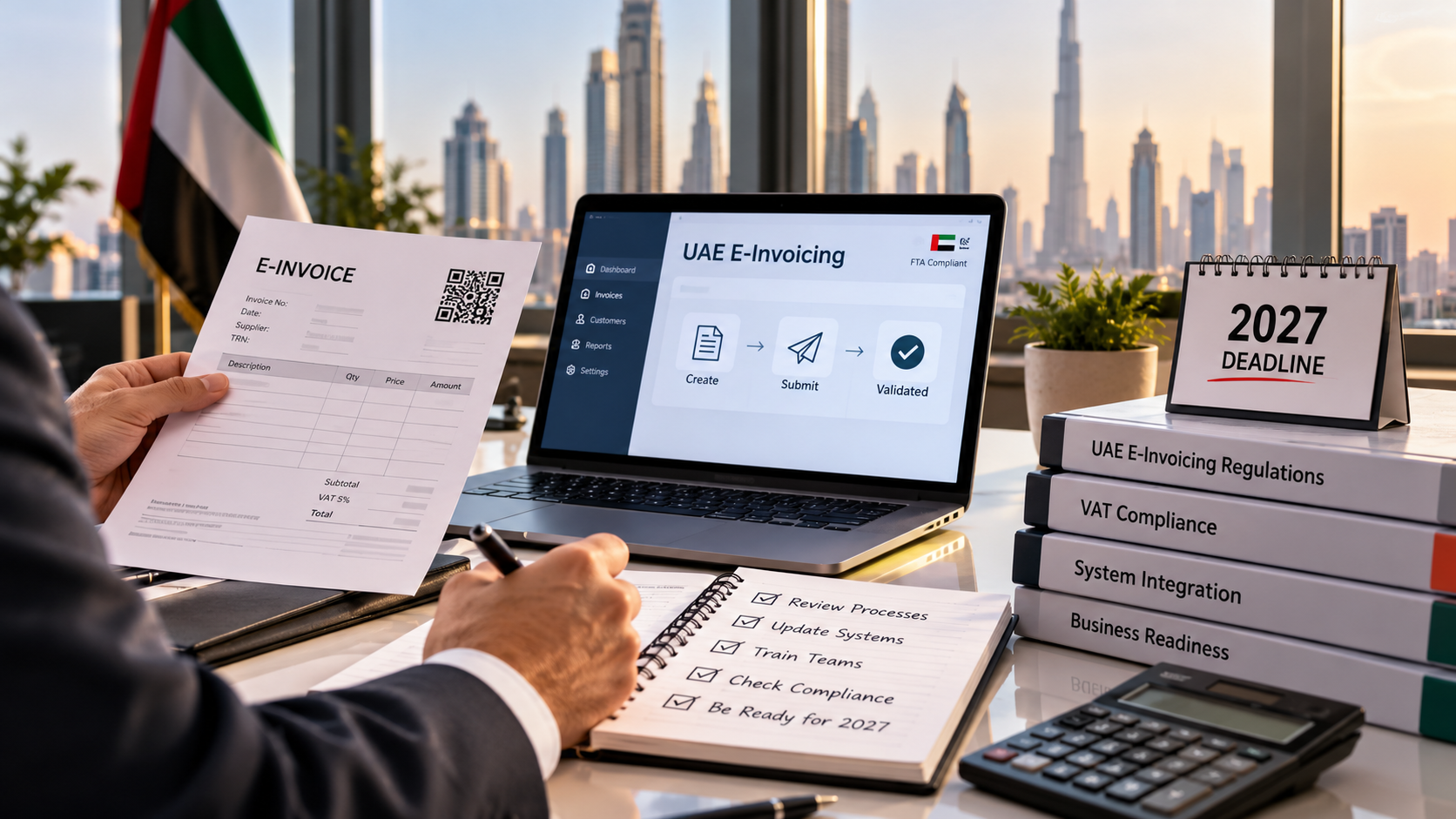
The UAE is moving towards a more digital tax environment, and businesses need to start preparing for the upcoming UAE e-invoicing 2027 deadline. E-invoicing is not simply about replacing paper invoices or PDF files with electronic documents. It involves structured invoice data, accounting systems, digital processes and the way businesses exchange transaction information.
For companies in Dubai and across the UAE, early preparation can make the transition smoother and reduce the risk of last-minute technical or compliance issues.
Businesses should therefore use the months before implementation to review their accounting systems, invoice processes, customer data, VAT information and internal controls.
What Is UAE E-Invoicing?
UAE e-invoicing is part of the country’s move towards digitalising business transactions and tax reporting.
Unlike a traditional PDF invoice, an e-invoice contains structured data that can be processed electronically. This means businesses need systems capable of generating, exchanging and handling invoice information in the required format.
The UAE is introducing e-invoicing through a phased implementation framework. Certain businesses will have implementation requirements beginning in 2027, while other businesses will follow according to the applicable phases and criteria.
Because implementation involves technology as well as finance processes, businesses should start preparing before their applicable deadline.
Why Should Businesses Prepare for E-Invoicing Early?
Waiting until the deadline can create unnecessary pressure.
A business may need to make changes to its:
- Accounting software
- ERP system
- Invoice-generation process
- Customer and supplier database
- VAT configuration
- Finance workflows
- Internal controls
- Record-keeping procedures
Businesses may also need to select and integrate an appropriate Accredited Service Provider where required.
Starting early gives finance and management teams enough time to identify problems, test systems and train employees before e-invoicing becomes part of everyday operations.
1. Understand Your E-Invoicing Requirements
The first step is to understand how the UAE e-invoicing framework applies to your business.
Companies should review their:
- Business activities
- Revenue and applicable thresholds
- Implementation phase
- Transaction types
- Invoicing volume
- Accounting systems
- Reporting requirements
Businesses should not assume that the same implementation process will apply to every company.
Understanding your specific requirements first will make it easier to create a realistic preparation plan.
2. Review Your Existing Invoicing Process
Before changing technology, businesses should understand how invoices are currently created and processed.
Ask simple questions:
- Who creates sales invoices?
- Which system generates them?
- How is VAT calculated?
- Who approves invoices?
- How are invoices sent to customers?
- How are credit notes created?
- Where are invoices stored?
- How are errors corrected?
Mapping the current process can reveal manual steps and weaknesses that should be addressed before e-invoicing implementation.
For businesses that need to strengthen their overall financial processes, professional Accounting Services in Dubai can provide support with bookkeeping, accounting records and financial reporting.
3. Check Your Accounting and ERP Software
Your accounting or ERP system will be central to e-invoicing.
Businesses should determine whether their existing software can support the required e-invoicing process or whether an upgrade or integration will be necessary.
Review whether the system can properly manage:
- Customer information
- Supplier information
- VAT numbers
- Invoice numbers
- VAT calculations
- Credit notes
- Debit notes
- Transaction classifications
- Invoice records
- Digital data exchange
Businesses should involve both finance and IT teams in this review.
A system may technically generate invoices but still create problems if it does not integrate properly with the company’s wider accounting workflow.
4. Clean Your Customer and Supplier Data
Poor-quality data can become a significant problem during e-invoicing implementation.
Before moving to structured electronic invoices, businesses should review their customer and supplier master data.
Check details such as:
- Legal business name
- Address
- Tax Registration Number
- VAT status
- Contact information
- Customer classification
- Supplier information
Duplicate or outdated records should also be identified.
Clean master data can reduce invoice errors and make the transition to a digital invoicing system easier.
5. Review Your VAT Invoice Information
E-invoicing does not remove the need for proper VAT compliance.
Businesses should review whether their accounting systems correctly handle different VAT treatments and invoice requirements.
Pay particular attention to:
- Standard-rated supplies
- Zero-rated supplies
- Exempt supplies
- Reverse charge transactions
- Credit notes
- Debit notes
- VAT adjustments
Incorrect VAT information can flow directly into financial and tax reporting, so businesses should resolve existing issues before implementing new invoicing technology.
Companies that need professional support can consider VAT Consultancy Services in Dubai to review their VAT processes and compliance requirements.
6. Choose the Right E-Invoicing Service Provider
Businesses that need an Accredited Service Provider should evaluate their options carefully.
Price should not be the only consideration.
Businesses should compare providers based on:
- ERP compatibility
- Integration capabilities
- Security
- Scalability
- Implementation support
- Customer service
- Reporting functionality
- Experience with UAE businesses
The right solution should fit into the company’s existing finance workflow and minimise unnecessary manual work.
7. Test the E-Invoicing Integration
Once the technology solution has been selected, businesses should conduct proper testing before implementation.
Test common transactions such as:
- Standard invoices
- Credit notes
- Debit notes
- VAT transactions
- Customer changes
- Supplier changes
- Reverse charge transactions
- Invoice corrections
- Error handling
Testing should not be limited to the IT department.
Finance and accounting teams should also participate because they understand the practical requirements of invoice processing and reconciliation.
8. Train Your Finance Team
A successful e-invoicing transition requires trained employees.
Finance and accounting staff should understand:
- How invoices will be generated
- How customer information is maintained
- How VAT details are checked
- How errors are corrected
- How credit notes are processed
- How rejected transactions are handled
- Where electronic records are stored
Businesses should clearly define responsibilities so employees know who handles technical errors, invoice corrections and compliance-related issues.
9. Review Internal Financial Controls
E-invoicing can change the way financial information moves through a business.
Companies should review who can:
- Create invoices
- Approve invoices
- Modify customer data
- Issue credit notes
- Change VAT information
- Correct invoice errors
Strong controls can reduce the risk of unauthorised changes and incorrect financial information.
Businesses may also consider an internal audit review to identify weaknesses in financial controls before implementing new digital processes.
10. Keep Accounting and Tax Records Organised
E-invoicing does not replace proper bookkeeping.
Businesses still need reliable accounting records that connect invoices with sales, purchases, VAT reporting and financial statements.
Maintaining organised records can also make reconciliation and future audits easier.
For growing businesses, professional bookkeeping can help ensure that invoices, expenses, VAT records and supporting documents remain properly organised.
UAE E-Invoicing 2027 Preparation Checklist
Before the applicable deadline, businesses should aim to complete the following:
- Understand the applicable e-invoicing requirements
- Confirm the implementation timeline
- Review the current invoicing process
- Check accounting and ERP capabilities
- Clean customer and supplier data
- Verify VAT information
- Evaluate an Accredited Service Provider where applicable
- Plan system integration
- Test invoice workflows
- Train finance employees
- Review internal controls
- Establish error-handling procedures
- Organise accounting records
- Monitor official UAE tax updates
This checklist can help businesses identify gaps early rather than discovering them close to the implementation deadline.
Common Mistakes to Avoid Before UAE E-Invoicing
Waiting Until the Deadline
Technology changes, integration and employee training can take time. Delaying preparation can create unnecessary operational pressure.
Treating E-Invoicing as Only an IT Project
E-invoicing affects accounting, VAT, finance, management and internal controls. All relevant teams should be involved.
Ignoring Master Data
Incorrect customer, supplier or VAT information can result in invoice errors and reporting problems.
Choosing a Provider Without Checking Integration
A provider should work effectively with your existing accounting or ERP system.
Forgetting VAT Compliance
Electronic invoices still need to reflect the appropriate VAT treatment. E-invoicing does not replace existing VAT obligations.
How Can Dubai Businesses Prepare for E-Invoicing?
The most effective approach is to treat e-invoicing as a business and finance transformation project, not simply a software upgrade.
Start by understanding your applicable requirements. Then review your current invoice process, accounting software, data quality and VAT controls.
After that, select the appropriate technology or service provider, test the integration and train your finance team.
Businesses that prepare early will have more time to identify technical, accounting or operational issues before implementation.
Frequently Asked Questions
What is the UAE e-invoicing 2027 deadline?
The UAE is introducing e-invoicing through a phased framework. Certain businesses will have implementation requirements beginning in 2027, while other businesses will follow according to their applicable phase and criteria.
What should businesses do before the UAE e-invoicing deadline?
Businesses should review their accounting and ERP systems, invoicing processes, customer and supplier data, VAT configuration, internal controls and employee training.
Does e-invoicing replace VAT compliance?
No. Businesses must continue meeting their applicable UAE VAT requirements. E-invoicing is part of the wider digital tax environment.
Do businesses need an Accredited Service Provider?
Businesses subject to the applicable e-invoicing requirements may need to work with an Accredited Service Provider under the UAE implementation framework.
Why should businesses clean their data before e-invoicing?
E-invoicing relies on structured and accurate transaction information. Incorrect customer, supplier or VAT data can create errors and additional manual work.
Final Thoughts
The UAE e-invoicing 2027 deadline should not be treated as a last-minute compliance task.
Businesses in Dubai and across the UAE should start by reviewing their invoicing processes, accounting systems, VAT information, master data and internal controls.
Early preparation can help businesses identify gaps, improve financial processes and make the transition to electronic invoicing more manageable.
If your business needs support with accounting, bookkeeping or VAT compliance, Irtiqa Al Falah provides professional accounting and VAT consultancy services in Dubai to help businesses prepare for changing UAE tax and financial requirements.