UAE Accounting Record Requirements in 2026: Business Guide
Keeping financial records organised is essential for every business operating in the UAE. Whether you run a small trading company, a consultancy or an established organisation, your invoices, expenses, bank transactions and tax documents need to be accurate and accessible.
In 2026, record keeping deserves particular attention following the introduction of Federal Tax Authority (FTA) Decision No. 4 of 2026, which sets rules for maintaining information contained in accounting records and commercial books. The decision took effect on 30 July 2026.
For businesses, this means reviewing not only which documents are retained but also how they are stored, whether copies are complete and legible, and how quickly records can be provided when requested.
Here is what UAE businesses should understand and prepare for.
1. What Has Changed in 2026?
FTA Decision No. 4 of 2026 establishes requirements for maintaining accounting records and commercial books, including records retained as electronic copies or photocopies.
The decision requires records to be complete, consistent with the original documents and clearly readable. Businesses must also provide the Federal Tax Authority with access to the records and the systems in which they are stored when requested.
This is particularly relevant to businesses that rely on scanned receipts, cloud accounting platforms, digital archives or outsourced bookkeeping.
Simply saving a document is not enough if important pages are missing, the information cannot be read or the records cannot be retrieved when needed.
2. Which Accounting Records Should Businesses Maintain?
The documents a business needs depend on its activities, tax obligations and financial arrangements. However, maintaining a well-organised set of core records is a practical starting point.
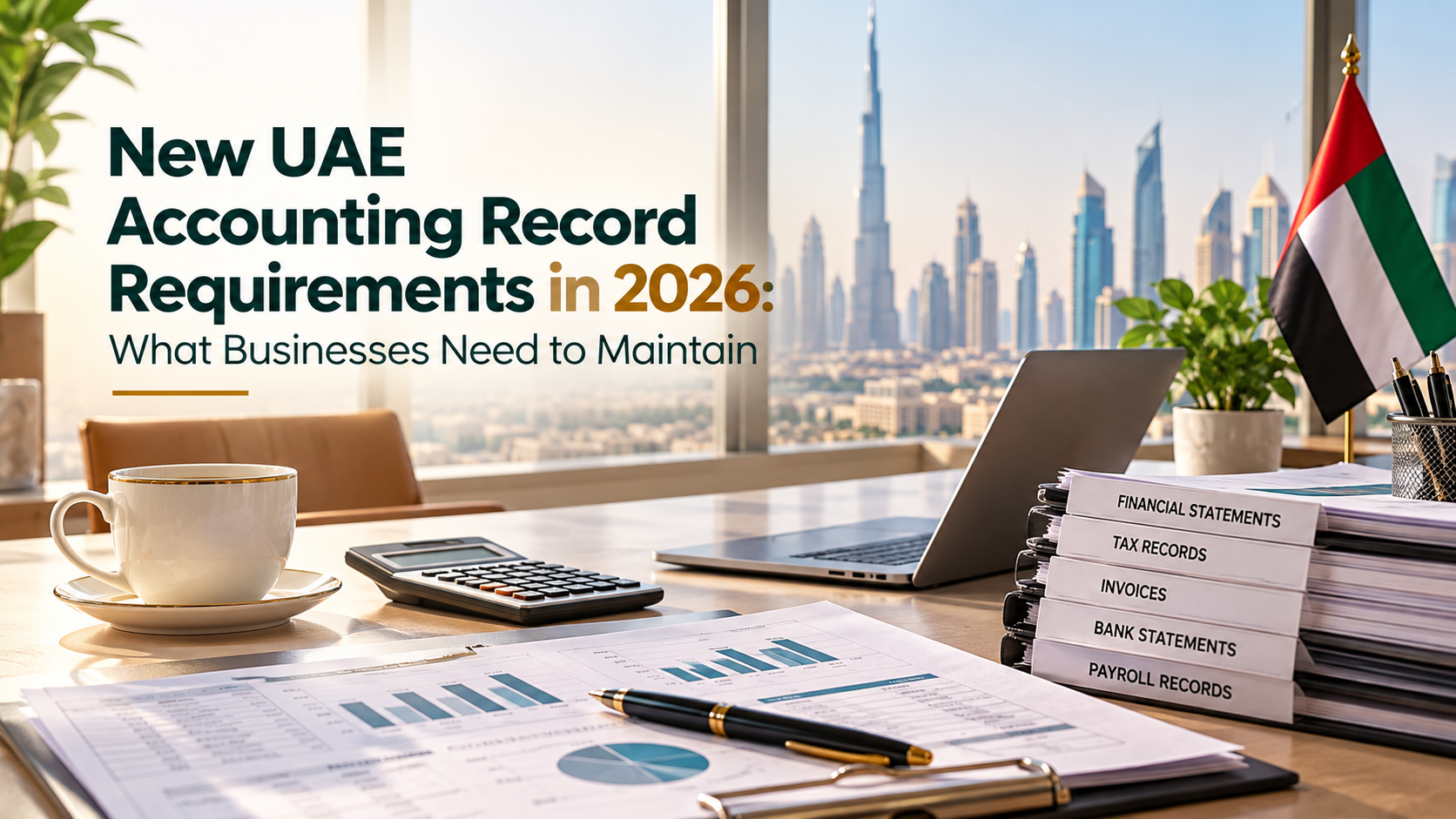
Sales and Purchase Records
Keep sales invoices, supplier invoices, credit notes, purchase orders and relevant delivery records. These documents help establish what was sold or purchased and support the corresponding accounting entries.
Bank Statements and Payment Records
Retain business bank statements, payment confirmations, receipts and supporting documentation for significant transactions. These records help reconcile the accounting ledger with actual cash movements.
Expense and Payroll Documents
Maintain expense receipts, employee-related payment records and other supporting documents relevant to the business’s operations.
Asset and Liability Records
Track business assets, purchases and disposals, outstanding liabilities, loans and relevant financing agreements. The FTA identifies transaction records, asset records and liability records among the important documents supporting Corporate Tax reporting.
Tax and Financial Records
Keep VAT returns, tax calculations, relevant supporting invoices, financial statements and Corporate Tax records as applicable.
Organising these documents throughout the year makes month-end reconciliation, tax preparation and financial reporting easier.
3. Ensure Digital and Scanned Copies Are Complete
One of the important practical aspects of the 2026 decision is the quality and completeness of electronic copies and photocopies.
Under the decision, copies must preserve the information in the original document, including all pages in the same order. Partial scanning is not accepted under the specified requirements. Copies must also be sufficiently clear and legible.
Businesses should therefore review their document-scanning procedures.
For example, if a supplier invoice contains three pages but only the first page is scanned, the stored record may be incomplete. Similarly, a faded receipt or unreadable scan may not provide an adequate record.
Use a consistent process for scanning, naming, checking and filing documents. Where appropriate, retain the original documents as well.
4. Understand Record Retention Periods
Record retention requirements vary according to the type of record and the applicable tax legislation.
| Record category | General retention requirement |
| UAE Corporate Tax records | At least seven years following the end of the relevant Tax Period. |
| VAT invoices | At least five years, subject to applicable exceptions. |
| Other accounting and commercial records | The applicable period depends on the relevant legal requirement and the record category. |
| Real estate records | Specific extended retention rules may apply. |
The FTA confirms that Corporate Tax records generally need to be retained for at least seven years after the end of the relevant Tax Period, while VAT invoices must generally be kept for a minimum of five years.
Additional retention periods or extensions may apply in specific circumstances, including tax audits and disputes. Businesses should check the applicable rules before disposing of old records.
5. Make Records Accessible and Secure
Financial records should be organised so that authorised staff can retrieve them efficiently without compromising confidentiality.
Under FTA Decision No. 4 of 2026, businesses must provide access to the records and the systems in which they are stored when requested. Where electronic copies are protected by passwords or encryption, the decision requires the necessary access credentials to be provided to enable access by the Authority.
Practical measures include:
- Using consistent file names and folder structures.
- Restricting access to authorised personnel.
- Maintaining reliable backups.
- Testing document retrieval periodically.
- Keeping records readable throughout the retention period.
- Reviewing the access arrangements of external bookkeeping or storage providers.
Businesses may engage third parties to maintain records, but the decision states that the business remains legally responsible for maintaining and safeguarding them.
6. How Accounting and Bookkeeping Services Can Help
Maintaining accurate records requires regular attention. When invoices are filed late, expenses are not categorised properly or bank transactions remain unreconciled, year-end reporting becomes more difficult.
Professional Accounting Services in Dubai can help businesses maintain organised financial records, reconcile transactions and prepare information for reporting.
Similarly, Bookkeeping Services in Dubai can support routine transaction recording, invoice management, expense tracking and document organisation.
Irtiqa Al Falah provides accounting, bookkeeping and tax-related services for businesses in Dubai and the UAE. Explore Irtiqa Al Falah’s website to learn more about its services and discuss your record-keeping requirements.
7. A Practical Checklist for UAE Businesses in 2026
Before your next reporting period, review the following:
- Are sales and purchase invoices filed completely?
- Are bank statements reconciled with accounting records?
- Are expense receipts and supporting documents available?
- Are digital copies clear, complete and readable?
- Can records be retrieved promptly when requested?
- Are access permissions and backups reviewed regularly?
- Are Corporate Tax and VAT records retained for the required periods?
- Have you checked the latest FTA guidance applicable to your business?
Addressing these points early can reduce the risk of missing documentation and make routine accounting work more manageable.
Conclusion
The UAE’s 2026 accounting record requirements reinforce the importance of complete, legible, accessible and properly maintained financial documentation.
FTA Decision No. 4 of 2026 makes the quality of stored records particularly important, including when businesses use electronic copies, scanned documents or third-party record-keeping services.
Businesses should review their existing procedures, confirm the retention periods that apply to their records and ensure their accounting systems support efficient retrieval.
If your business needs help with Accounting Services in Dubai, Bookkeeping Services in Dubai or tax record preparation, Irtiqa Al Falah can be a starting point for discussing your accounting requirements.
Frequently Asked Questions
It is a Federal Tax Authority decision setting rules and requirements for maintaining information contained in accounting records and commercial books. It addresses completeness, legibility, access and the quality of electronic or photocopied records.
Corporate Tax records generally need to be retained for at least seven years following the end of the relevant Tax Period. Specific circumstances may require additional retention.
The 2026 decision addresses electronic copies and photocopies, provided the applicable requirements for completeness, accuracy, legibility and access are met.
Yes. The decision permits businesses to engage a third party to maintain records and commercial books. However, the business remains legally responsible for maintaining and safeguarding them.
Use consistent filing procedures, reconcile accounts regularly, retain supporting documents, maintain readable digital copies and review retention requirements. Professional bookkeeping support can help establish a more consistent process.
Need Help Managing Your Accounting Records in the UAE?
Stay prepared for UAE accounting and tax compliance requirements with professional support from Irtiqa Al Falah. Our accounting, bookkeeping and tax-related services help businesses maintain organised financial records, improve documentation practices and prepare for reporting obligations.
Contact Irtiqa Al Falah today to discuss your accounting and bookkeeping needs and build a more reliable financial record-keeping process.
Visit: https://irtiqaalfalah.com/